Careers
Part of Getting media relations right the first time
Quiet budget leaks hidden inside media relations mistakes
media relations mistakes waste budget through irrelevant lists, weak stories, hidden sponsorship, slow answers, poor source prep, and vanity reports.
What to take away
- Irrelevant outreach creates cost and weakens future access.
- Hidden commercial relationships can turn a placement into a disclosure and credibility problem.
- Slow fact handling wastes opportunities that more distribution cannot recover.
Media relations mistakes waste marketing budget when a team pays for activity that cannot help a journalist or the intended public. The visible costs include databases, retainers, production, events, monitoring, and executive time. The larger cost is a contact history that teaches journalists to ignore the sender.
Find the quiet budget leaks
Hidden cost
- Buying the largest list
- Research debt and irrelevant volume
- Pitching no real development
- Writing and follow-up time with little value
- Overproducing a release
- Design spend cannot create news value
- Unprepared executives
- Canceled access, weak answers, and correction work
- Slow approvals
- The deadline passes
- Hidden paid relationship
- Disclosure, trust, and enforcement exposure
- Vanity monitoring
- Reporting hours produce no decision
Better control
- Buying the largest list
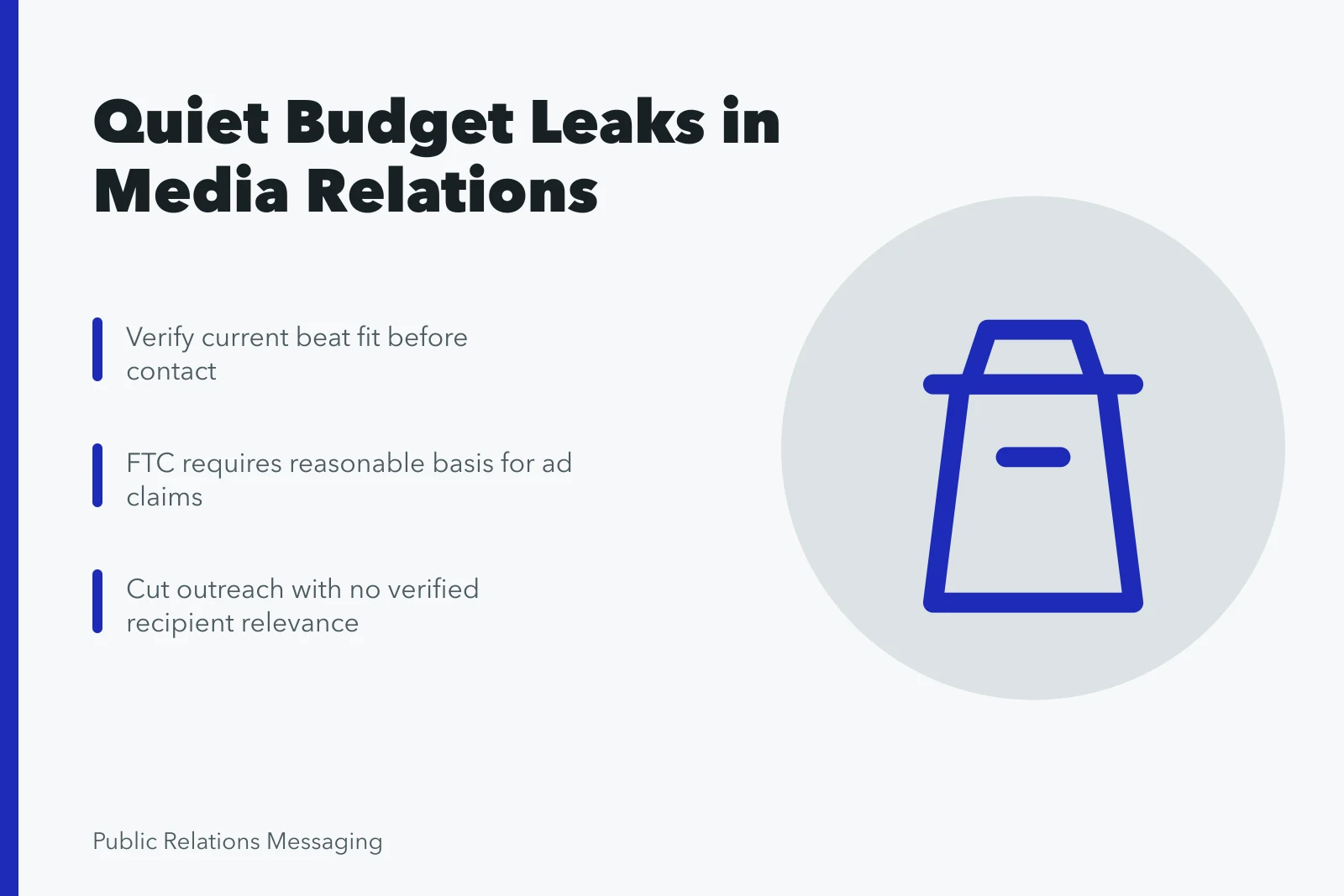
- Verify current beat fit before contact
- Pitching no real development
- Use an owned update or wait
- Overproducing a release
- Build a plain, sourced story file
- Unprepared executives
- Rehearse evidence and hard questions
- Slow approvals
- Create response tiers and named authority
- Hidden paid relationship
- Classify and disclose the arrangement
- Vanity monitoring
- Measure relevance, accuracy, response, and outcome
Audit the last quarter by useful outcome, not invoice line. Which stories were relevant? Which contacts were verified? Which sources were ready? Which inquiries were fulfilled? Which errors required repair? Which coverage helped the intended public understand or act? Stop recurring work that lacks a defined contribution, and move budget toward evidence, access, response, and learning.
Score each check from 1 to 5 and cut any line that scores 2 or lower.
Typical planning ranges help a team size the problem. A media database seat runs about $200 to $1,000 a month per user. A tailored pitch takes 1 to 3 hours of research, writing, and follow-up. Weekly monitoring takes 3 to 6 hours, and much of it produces no decision.
A working list holds 20 to 60 verified contacts per campaign, and a typical cold reply rate sits in the low single digits. Seat count, beat breadth, vendor, and contract length set the real figure.
Spend to remove first, ranked by effort against return:
- Outreach with no verified recipient relevance. Typical saving: 1 to 3 hours per pitch, plus the access it protects.
- Duplicate monitoring seats and unused dashboards. Typical recovery: a few hundred to a few thousand dollars a year, set by seat count and contract terms.
- Production for a release no reporter will use. Typical saving: 4 to 10 hours per item across design, review, and approval.
- Reports nobody reads before a decision. Typical saving2 to 5 hours a month per analyst.
A mass pitch often looks efficient because the send cost is low. It externalizes the cost to recipients and creates internal noise: bounced contacts, duplicate follow-ups, opt-outs, misleading response rates, and manual cleanup. Require a reason for every recipient. Sample the list before sending and stop when the story is too broad to personalize honestly.
Media relations mistakes and controls
Mistake
- Buying largest list
- Research debt
- Pitching no development
- Writing time
- Overproducing release
- Design spend
- Unprepared executives
- Canceled access
- Slow approvals
- Deadline passes
- Hidden paid relationship
- Trust exposure
- Vanity monitoring
- Reporting hours
Hidden cost
- Buying largest list
- Verify beat fit
- Pitching no development
- Owned update or wait
- Overproducing release
- Plain sourced story file
- Unprepared executives
- Rehearse hard questions
- Slow approvals
- Response tiers, named authority
- Hidden paid relationship
- Classify and disclose
- Vanity monitoring
- Measure relevance and outcome
Better control
- Buying largest list
- Pitching no development
- Overproducing release
- Unprepared executives
- Slow approvals
- Hidden paid relationship
- Vanity monitoring
Earned, owned, sponsored, affiliate, and paid editorial products need accurate labels inside the organization and where audiences receive them. Never report sponsored placement as independent coverage, and do not ask employees, customers, experts, or creators to hide a material relationship.
Free products, travel, access, and payment can affect disclosure analysis. Clear labels matter because common media relations questions cover paid placement, disclosures, and corrections before any pitch goes out.
The FTC's Disclosures 101 guide for social media influencers explains that material connections with brands should be disclosed so people can evaluate endorsements.
PRSA's advisory on ethics and social media disclosure says sponsorship and affiliations should be clear and identifiable and discusses organizational authority and legal review. Both are professional guidance for U.S. work, not an adjudication or a substitute for current law.
Keep an evidence record for each decision
The GAO data reliability guide treats reliability as fitness for an intended use and requires documented assessment. Use that test on your own outreach data; the federal guide does not certify the local file.
The FTC advertising substantiation policy requires a reasonable basis before objective advertising claims are disseminated. Apply that U.S. rule to the performance numbers your team publishes, and name the evidence behind each one before release.
For media relations mistakes, keep the evidence record beside the decision so a reviewer can reproduce the reasoning without relying on memory. Set the next review date and name the change that would trigger an earlier check.
Common questions
Are press release distribution services a waste?
They are useful only when their audience, indexing, record, or regulatory function matches the objective. Distribution alone does not make a story relevant.
Is a low email response rate always bad?
It may indicate poor fit or timing, but raw response rate also ignores silent use, later reporting, and the small number of outlets that actually matter.
What should be cut first?
Cut outreach with no verified recipient relevance, production with no reporting use, duplicated monitoring, and reports that do not support a decision.