Reviews
Part of Getting media relations right the first time
The media relations questions worth asking before anything else
common media relations questions cover news value, pitches, releases, spokespeople, deadlines, embargoes, corrections, paid placement, records, and measurement.
What to take away
- A journalist evaluates a story for an audience, not for the sender's campaign calendar.
- Timely facts and responsive sources matter more than repeated follow-up.
- Paid placement, earned coverage, and owned content should never be mislabeled.
Common media relations questions usually have conditional answers. The right choice depends on the development, outlet, journalist, public need, evidence, timing, risk, and the organization's ability to respond. Use the table as a starting point, then document the exact decision.
Answer the operating questions
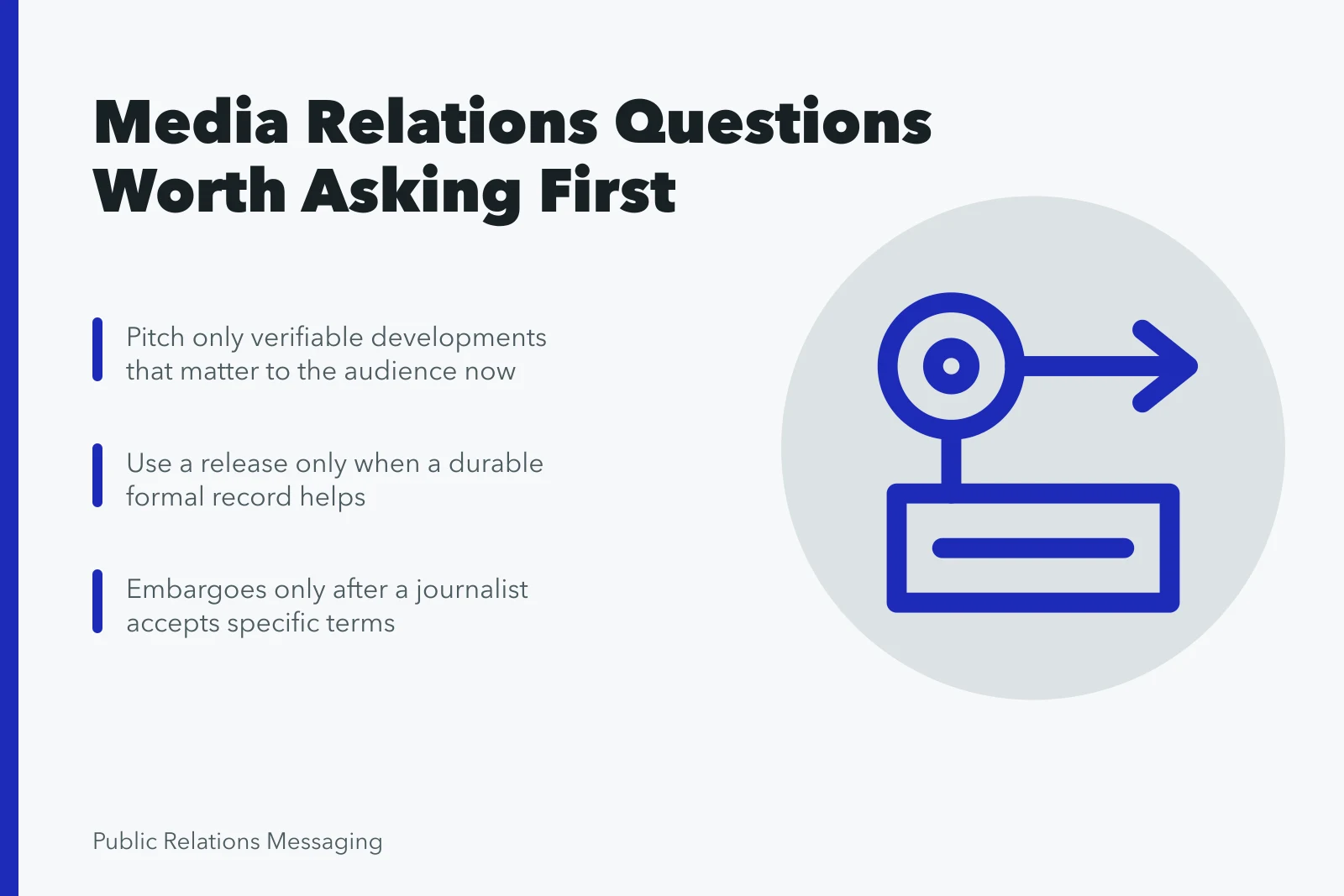
Two answers come first. Treat a development as newsworthy only when a verifiable fact matters to the outlet's audience now. Send a release only when a durable formal record helps the reporting task. The rest follows from those two tests.
| Question | Working answer |
|---|---|
| Is this newsworthy? | Only if a verifiable development matters to the outlet's audience now |
| Do we need a release? | Only when a durable formal record helps the reporting task |
| Who should pitch? | A clearly identified person who understands the story and can respond |
| How long should it be? | As short as accuracy and relevant context allow |
| Can we use an embargo? | Only after a journalist accepts specific terms |
| What is off the record? | A ground rule agreed before information is shared |
| Should we answer after hours? | Set coverage and escalation based on the issue and real risk |
| What if a fact is wrong? | Verify, notify the journalist promptly, and supply the correct record |
| Is coverage guaranteed? | No. Editorial control belongs to the outlet |
Journalists often work to deadlines that differ by format and story. Ask for the real deadline, the requested response form, the topics under examination, and what supporting material would help. Do not make participation conditional on advance questions, quote approval, favorable framing, or knowledge of every other source unless a specific legitimate constraint requires qualified advice.
The CDC's Division of Media Relations page gives journalists a defined request route, operating hours, after-hours handling, and notice that scientific experts may not always be available. It illustrates clear service expectations at one federal agency, not a response-time standard for private companies.
Private companies set their own media windows. A typical arrangement is a named on-call contact during business hours and an escalation path to a duty manager overnight. The substantive answer often comes the next business day.
Typical acknowledgment times run from a few hours to one business day. The figure depends on staffing, sector, and the risk in the issue. Publishing the window helps reporters plan.
A media contact should acknowledge the request, identify the owner, and say when a substantive answer is possible. If the organization cannot comment, state the decision clearly and avoid invented excuses. A narrow factual answer may be better than a broad statement. Log what was asked, what was supplied, who approved it, and which promises remain open.
The Justice Department's information page for journalists publishes its principal media contact, hours, inquiry route, after-hours handling, and technical pool-feed details. That institutional example supports transparent access logistics, while its government setting and operational choices are not private-sector requirements.
Measure whether the media operation helps accurate reporting and a defined public outcome. Track relevant request completion, fact turnaround, qualified source access, correction rate, and coverage accuracy.
Track audience fit, message comprehension, and response quality. Mention count alone can reward irrelevant or harmful attention. Teams wanting outside help should compare best public relations strategy agencies on evidence, not reputation.
Resolve the question with a decision record
The GAO evaluation design guide connects evaluation questions with evidence needs and design choices. Use the same discipline on media relations questions. Federal evaluation guidance does not make a local marketing result causal or transferable.
The W3C Privacy Principles statement warns against shifting privacy work to individuals. Treat it as a checklist for data handling, then check the governing law and configuration.
For common media relations questions, keep the evidence record beside the decision so a reviewer can reproduce the reasoning without relying on memory.
Example record, filled in for an illustrative case:
Decision record
- Date and time
- Tuesday, 14:20 ET
- Question
- pitch the supplier recall story, or send a release?
- Outlet and journalist
- regional business desk, manufacturing reporter
- Public need
- recall notice covers units sold in three states
- Evidence in hand
- company recall notice, regulator posting, hotline log
- Deadline given
- facts needed by 16:00 ET that day
- Owner
- corporate communications lead
- Decision
- pitch the reporter, no release
- Reason
- the notice is the public record and a release adds delay without new facts
- Follow-up
- hotline and unit details sent by 15:00 ET, update if counts change
Common questions
When should a company issue a press release?
Use one when a formal, durable announcement with complete facts, contacts, and supporting material helps the intended reporting or public task.
Can a spokesperson review quotes?
A journalist may check facts or quotations voluntarily, but an organization should not assume approval rights. Clarify the outlet's process before the interview.
What does no comment communicate?
It can imply more than intended. When possible, explain the legitimate limit, state what can be confirmed, and offer a realistic update path.