Careers
Part of Marketing communications strategy: the version that survives contact with reality
A field guide to marketing communications strategy signals worth tracking
marketing communications strategy trends include synthetic content controls, claim testing, discovery, first-party evidence, accessibility, and correction speed.
What to take away
- Treat trends as monitored signals, not certain forecasts.
- Faster content production increases the need for evidence, provenance, and approval controls.
- Human understanding and service outcomes matter more as platform metrics fragment.
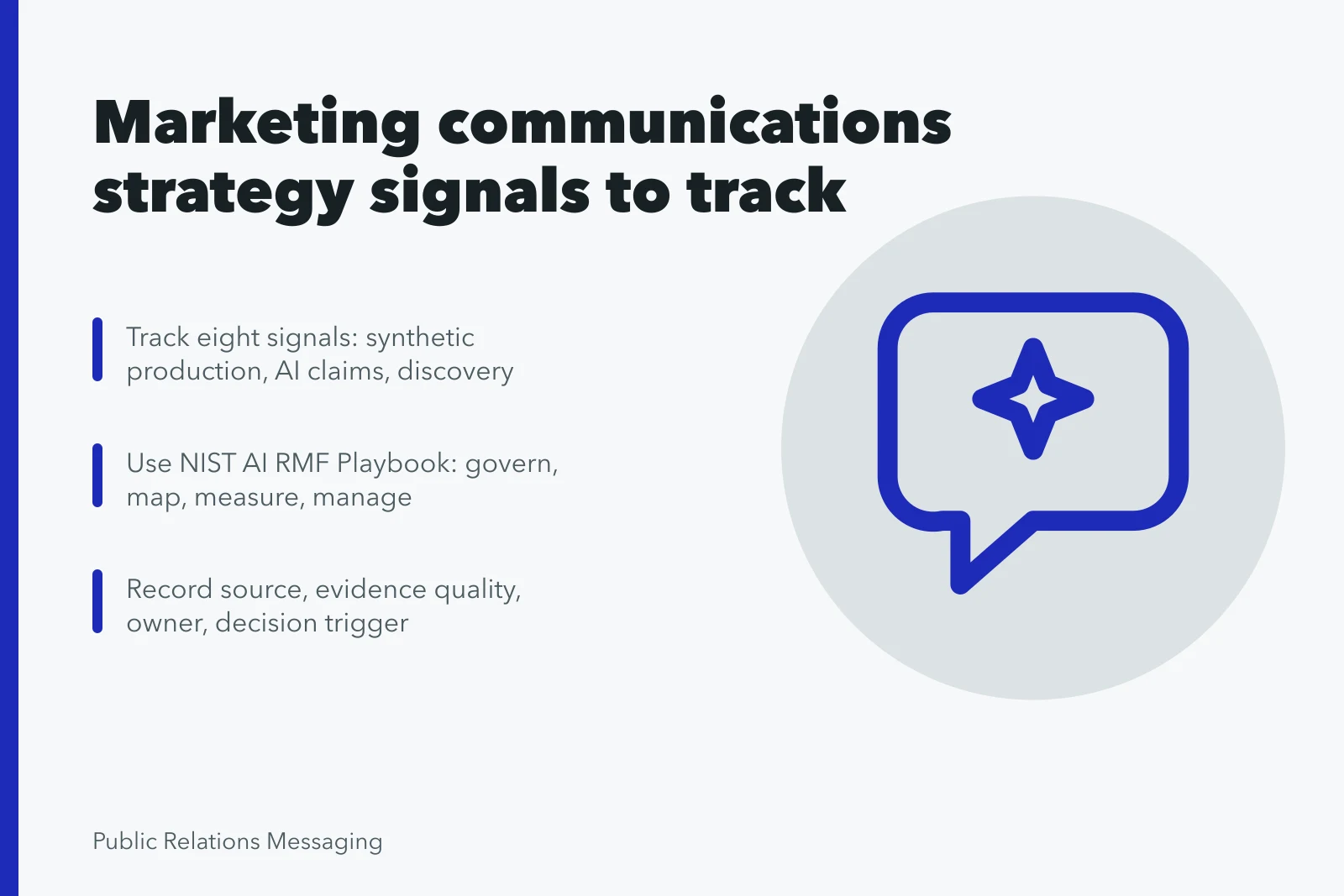
Marketing communications strategy trends should be kept in a dated watchlist. For each signal, record the source, evidence quality, audience relevance, possible effect, owner, decision trigger, and next review. Separate an observed change from a forecast and a forecast from a plan. Teams should not redesign their program around a headline.
Track eight practical signals
| Signal | Strategy question | Control |
|---|---|---|
| Synthetic production | Which content can be generated or altered? | Restricted use, source checks, rights, and approval |
| AI capability claims | What exact performance is being promised? | Claim-matched testing and expiry |
| Fragmented discovery | Where does each audience now seek answers? | Journey research and durable source content |
| Closed measurement | Which platform events cannot be verified? | Raw exports, experiments, and interpretation limits |
| First-party evidence | What can be learned through direct service? | Purpose limits, data quality, and consent review |
| Accessibility demand | Who cannot receive or act on the message? | Inclusive briefs and production tests |
| Automated personalization | Which variants and audiences can change live? | Boundaries, logs, sampling, and pause authority |
| Trust and correction | How quickly can an error be found and repaired? | Provenance, monitoring, notice, and root-cause review |
Generative systems speed text, images, audio, and video, but speed does not establish truth, ownership, audience fit, or safety. Define allowed inputs, confidential-data boundaries, source expectations, identity and synthetic-media rules, human review, version records, and prohibited claims.
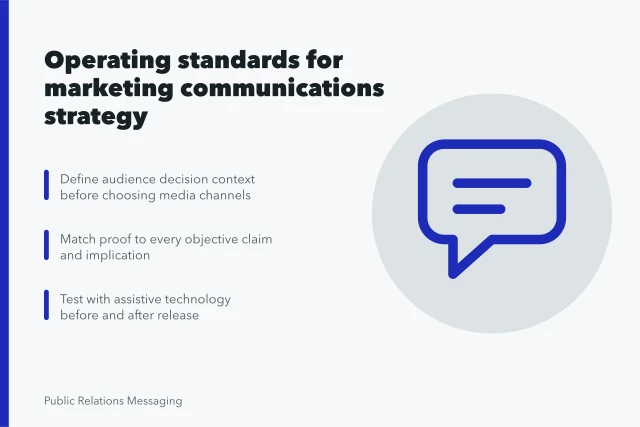
Recheck the final artifact, not just the first draft. A marketing communications strategy checklist covers objectives, audience research, message proof, and channel jobs, so teams can verify each artifact against agreed rules.
NIST's Generative AI Profile is a voluntary cross-sector companion to the AI Risk Management Framework that identifies risks and suggested actions across governance, mapping, measurement, and management. It does not certify a communication tool or decide whether a particular use is lawful or appropriate.
As discovery spreads across search, social feeds, assistants, communities, media, and internal recommendations, maintain a durable source of verified information. Track the questions people bring from each route, but avoid forcing them into one attribution story. Measure whether people arrive with accurate expectations and whether service resolves the promise.
Expect more pressure to prove what automated tools can do. A polished demo, vendor benchmark, anecdote, or fluent output may not support claims about accuracy, equivalence, savings, safety, personalization, or professional substitution. Define the exact claim, population, task, comparison, conditions, errors, and operator before testing.
The FTC's Operation AI Comply announcement reports multiple actions involving alleged AI-related deception, including claims about professional substitution, review generation, and business earnings. The matters have distinct records and procedural stages, so the announcement is not a technical test protocol or a finding about every AI product.
Prepare for faster correction. Keep account ownership, approved source files, placement lists, partner contacts, and pause procedures current. Monitor representative live variants and the full destination. When an error appears, preserve evidence, assess audience and harm, stop or limit distribution, correct controlled copies, communicate where appropriate, and repair the process that allowed recurrence.
Maintain a dated watchlist
The NIST AI RMF Playbook offers voluntary AI-risk actions under govern, map, measure, and manage. Use them when AI changes marketing communications strategy trends; the playbook is not a product ranking or forecast.
The W3C Privacy Principles statement gives web-system designers shared privacy concepts and warns against shifting privacy work to individuals. Apply it to marketing communications strategy trends, then review the governing law and configuration.
Common questions
Which 2027 trend matters most?
The answer depends on the audience and operating model. For many teams, synthetic production and automated distribution increase both opportunity and control risk.
Should a company publish more because production is cheaper?
Only when additional communication has a defined audience job, supportable message, service capacity, and measurement value.
How should a trend watchlist affect budgets?
Tie spending to explicit triggers, small tests, reversible commitments, and evidence that the change matters to the priority audience.