Operations
Part of Public relations strategy: the choices that shape everything else, 2027 edition
Public relations strategy best practices argued from results, not habit
public relations strategy best practices align conduct, verified facts, audience needs, media access, spokesperson readiness, accessible content, and correction.
What to take away
- Make organizational behavior and public claims agree.
- Answer the audience's real question before repeating a preferred message.
- Keep verification, follow-up, correction, and accessible alternatives operational at all times.
Public relations strategy best practices are habits for producing accurate, useful, responsive communication. They cannot guarantee attention, approval, trust, or favorable coverage. Apply them with current evidence and proportionate professional review for the issue, audience, jurisdiction, and risk.
The 1982 Tylenol withdrawal is the case most often cited: Johnson & Johnson pulled the product, published what it knew, and returned with tamper-resistant packaging. Widely reported figures put the cost above 100 million dollars, and the brand regained leadership within about a year.
Edelman's Trust Barometer, published each year since 2001, is one named measure of trust in institutions. Corrections issued inside the promised window, and time to a substantive reply, carry the most weight.
Adopt a working standard
| Practice | Observable behavior |
|---|---|
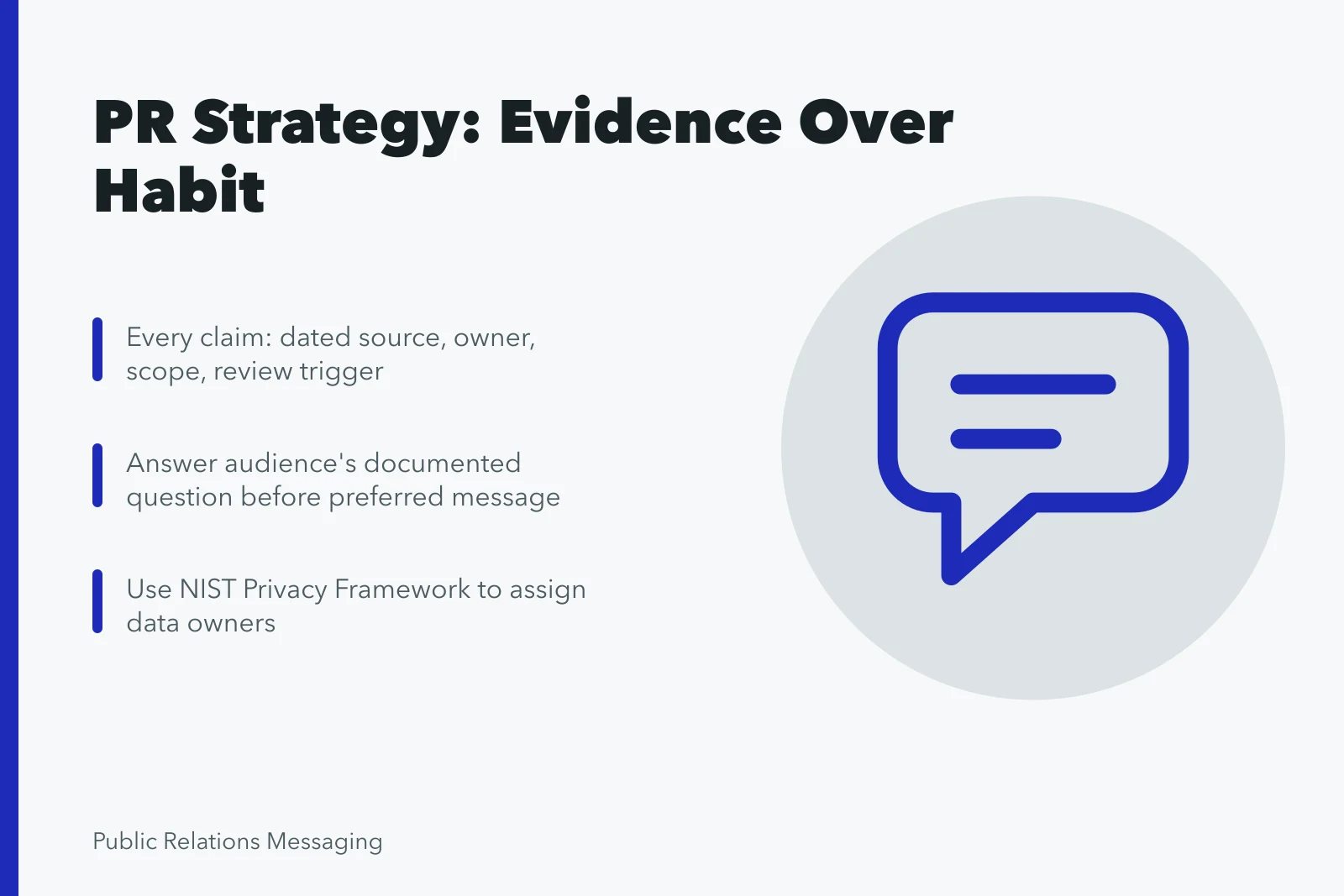
| Evidence first | Every material claim has a dated source, owner, scope, and review trigger |
| Public relevance | Messages answer a documented question or decision |
| Direct sequencing | Affected people and employees hear news through responsible routes |
| Editorial respect | Pitches are relevant, transparent, and free of coverage pressure |
| Prepared access | Qualified sources can answer hard questions and follow up |
| Accessible delivery | Formats and action paths work for varied audience needs |
| Visible correction | Material errors are fixed where exposed people can notice |
| Outcome learning | Research and results change organizational choices |
Maintain a source-backed question bank. For each question, record concise answer, evidence, and qualification. Record owner, approved speaker, disclosure limit, and follow-up route. Include skeptical questions.
Filled entry (illustrative):
Field / Entry
- Question
- Does the March change alter what an existing customer pays?
- Answer
- No for current contracts; new sign-ups pay the new rate from 1 May
- Evidence
- Pricing notice dated 12 March, contract terms section 4
- Owner
- Customer operations lead
- Follow-up route
- Written summary to affected accounts within five business days
If a fair question exposes a gap in product performance, service, policy, or remedy, assign it to the operating owner instead of an evasive line. Teams that skip this step repeat public relations strategy mistakes like selective facts and unprepared spokespeople.
CDC's guidance on spokesperson preparation recommends early designation, clear purpose, truthfulness, acknowledgement of uncertainty, scope discipline, preparation, concise answers, and follow-up in a patient-notification context. Those principles need adaptation outside health incidents.
Write for real conditions. Lead with the essential point, use familiar words, define necessary terms, separate actions, and label dates and amounts.
Channels need different tactics: news value for a reporter, one action for a customer, the answer itself in a public thread.
Name the responsible organization, do not hide a qualification in a distant document, make headings answer questions, have link text describe the destination, and give tables meaningful headers plus a readable alternative when the format requires it.
Digital.gov's plain-language guidance to write for the reader tells federal authors to identify the audience and purpose, consider what readers know and need, and address distinct audiences separately when appropriate. Businesses can test the same audience discipline without claiming federal compliance.
- Verify the final version against the source record
- Brief service teams before creating demand
- Confirm rights and accurate media credits
- Test captions, transcripts, alternative text, forms, and documents
- Log inquiries and deliver promised follow-up
- Sample live placements and destinations
- Publish corrections with an explanation of the material change
Assign the practice
The NIST Privacy Framework starting guide outlines a voluntary process for identifying and managing privacy risk. Use it to assign data and response owners for public relations strategy best practices; it is not legal clearance.
The CISA business-system logging guidance explains how event records support security review. Preserve appropriate public relations strategy best practices access, change, failure, and correction records without claiming that logging validates a metric.
Turn each practice into an owner, cadence, input, output, acceptance test, and correction path.
Field / Filled example: visible correction
- Owner
- Communications lead named in the media policy
- Cadence
- Weekly check of the correction log, quarterly audit
- Output
- Corrected item plus a dated change note
- Acceptance test
- A reader who saw the original finds the correction at the same URL
- Correction path
- Page owner rewrites, a second reviewer checks the wording
Observe the work during a normal reporting cycle and during one controlled failure. Keep the result with the metric definition and decision record.
Common questions
What is the most important PR best practice?
Align accurate communication with responsible conduct. A polished message cannot sustain a promise the organization does not keep.
Should a spokesperson answer every question?
Answer within verified knowledge and authority. Explain legitimate limits, avoid speculation, and follow up when a fact can be confirmed later.
How can a team make PR more accessible?
Include access needs in research and briefs, fund accessible formats, test representative final outputs, and provide a working route for help.