Strategy
Public relations messaging: FTC and SEC disclosure rules PR teams must follow
FTC endorsement and native ad rules plus SEC Regulation FD define what PR messaging can legally claim, and how materiality and press release review actually work.
What to take away
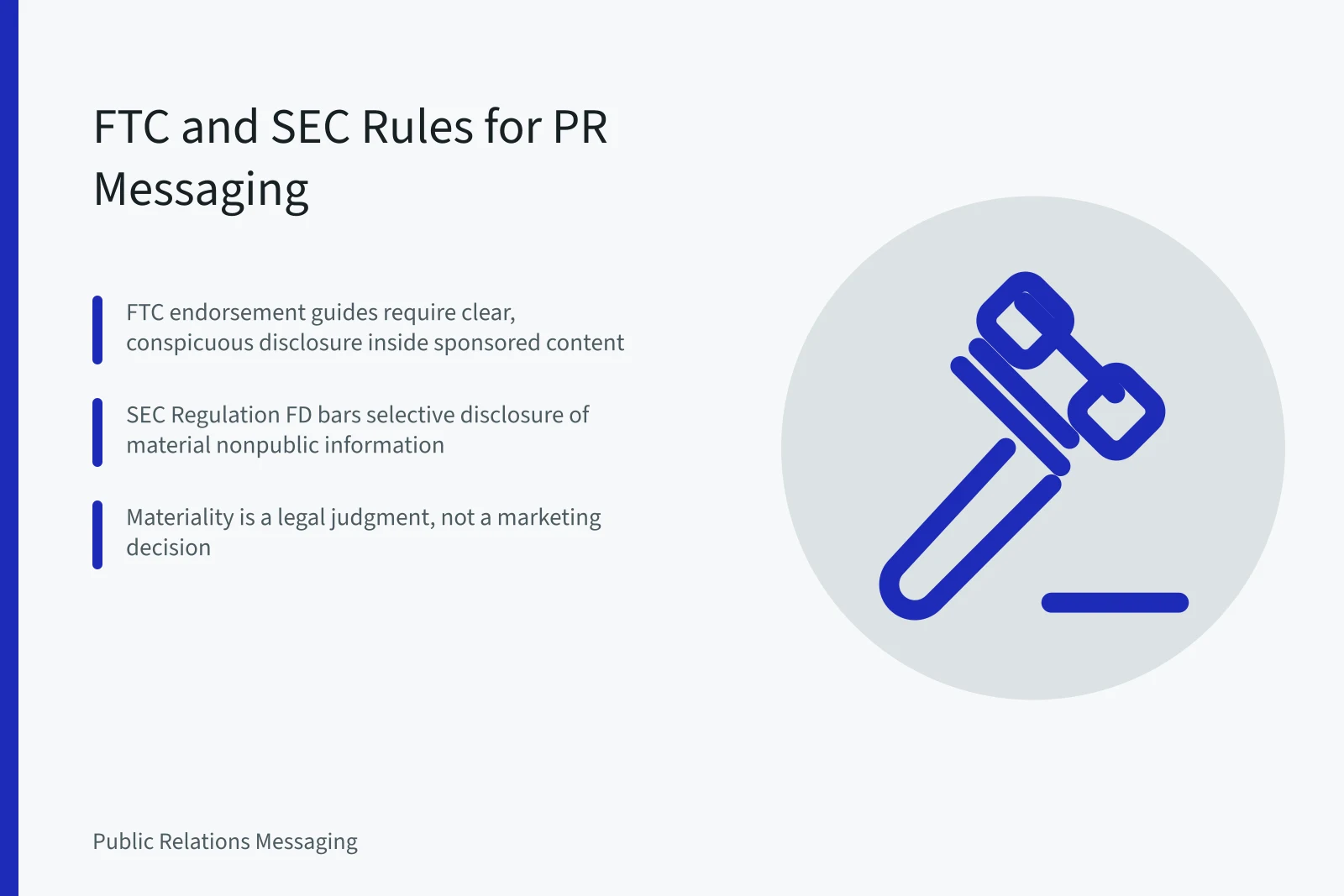
- The FTC endorsement guides require clear and conspicuous disclosure of material connections, and the disclosure must appear inside the sponsored content.
- SEC Regulation FD restricts selective disclosure of material nonpublic information to analysts and investors unless the company discloses it publicly at the same time or promptly.
- Materiality is a legal judgment about what a reasonable investor would consider important, not a marketing decision.
- A press release review checklist with a named approver and a written record keeps PR copy inside both regimes.
Where disclosure law constrains PR messaging
Public relations copy is commercial speech shaped by two federal regimes. The Federal Trade Commission polices advertising claims and endorsements under Section 5 of the FTC Act, which bars deceptive acts and practices. The Securities and Exchange Commission polices what public companies tell the market, largely through Regulation FD, adopted in 2000.
Neither agency asks whether a message is memorable or well written. They ask whether a reasonable audience would be misled, and whether one investor received information before the rest of the market did. A campaign that clears brand review can still fail both tests.
The FTC endorsement guides in influencer campaigns
The FTC's Disclosures 101 guidance tells influencers to disclose brand relationships clearly and conspicuously, in wording a viewer cannot miss. A #spon buried under twenty other hashtags does not meet that bar.
The FTC disclosures 101 guidance also covers video, live streams, and affiliate links, where the placement of the notice changes what counts as conspicuous.
The FTC native advertising guide applies the same logic to sponsored articles, paid placements, and any format that resembles editorial content. Readers must be able to tell advertising from news before they read the claim.
FTC endorsement guides in influencer campaigns
FTC endorsement and native ad rules
- Who is covered
- Brands, agencies, influencers, publishers
- What triggers review
- A material connection or paid placement
- Required action
- Clear and conspicuous disclosure
- Typical PR artifact
- Influencer brief, sponsored post, native article
SEC Regulation FD
- Who is covered
- Public companies and people acting for them
- What triggers review
- Material nonpublic information
- Required action
- Public disclosure at the same time or promptly
- Typical PR artifact
- Earnings script, analyst call, press release
SEC Regulation FD and the selective disclosure problem
Regulation FD applies when a company, or anyone acting on its behalf, gives material nonpublic information to securities analysts, institutional investors, or holders likely to trade on it. The SEC interpretive guidance on Regulation FD explains how the staff reads those situations.
Intent does not decide the outcome. A well meaning background call with one analyst can create a public disclosure obligation. PR staff who draft talking points and distribute the release are part of that chain, not bystanders to it.
Example: reviewing a partnership release
A draft announces a partnership with a named retailer and hints at future products. The reviewer works through a short list before the wire sees it.
Reviewing a partnership release
- Does the headline describe the deal or imply a larger one?
- Does any forward looking claim need a safe harbor statement?
- Are paid endorsers named, and are their disclosures written into the brief?
- Does the release contain a number that has never been filed or announced?
If the disclosure reads awkwardly next to the claim, the claim is usually the thing to fix.
Materiality calls and the press release review checklist
Materiality is decided by courts and regulators using a reasonable investor standard, not by a communications team. In practice, legal counsel, the CFO, and investor relations make the call, and PR supplies the facts and the draft.
Build the record deliberately:
- Name the approver for each claim.
- Mark every number with its source.
- Log the disclosure decision and the time it was made.
- Re-check the draft if the deal terms change.
Processes that hold under pressure
Rules only help when the workflow around them is decided in advance. A public relations strategy that names a disclosure approver before a crisis costs far less than one written afterward.
The marketing communications strategy behind a launch should say which claims need evidence, who reviews them, and how quickly a correction reaches the wire.
When teams compare marketing communications strategy tools, approval trails, evidence storage, exports, and retention settings belong in the scoring, not only research fit.