Reviews
Part of Public relations strategy: the choices that shape everything else, 2027 edition
Do public relations strategy mistakes trace back to one root decision?
public relations strategy mistakes include publicity-first goals, selective facts, weak controls, unprepared spokespeople, broken handoffs, and vanity measures.
What to take away
- Public relations strategy mistakes usually trace back to one root decision: whether attention or a verified public outcome governs the plan.
- Most serious failures begin before wording, in facts, conduct, ownership, or readiness.
- A technically true sentence can still mislead through omission and presentation.
- Coverage volume cannot rescue a message that creates false expectations.
Public relations strategy mistakes often look like communication problems only after publication. The decision that matters comes earlier: define the public outcome, then verify the facts, conduct, ownership, and delivery capacity behind it.
Get that decision wrong, and weak diagnosis, missing facts, and unrealistic promises follow. Unclear ownership, poor sequencing, and undeliverable experiences follow too. Fix the operating cause as well as the visible message.
The root decision behind the failure patterns
The root decision is whether the public outcome will govern tactics or whether attention will. That choice explains the seven patterns below. Each pattern is a symptom of choosing attention first.
A team that decides to earn a specific understanding or relationship outcome will still make errors. But the errors become correctable because facts and delivery are tested before publication.
Publicly reported cases follow that order. Volkswagen's 2015 diesel emissions admissions and Wells Fargo's 2016 fake-accounts scandal became communication crises after operating and incentive decisions. Johnson & Johnson's 1982 Tylenol recall put product withdrawal and safety information before promotion. The root decision differs.
Outside the United States, Ryanair's 2017 flight cancellations followed a pilot rostering error that left too few crews for the published schedule.
| Symptom | Why it fails | Repair |
|---|---|---|
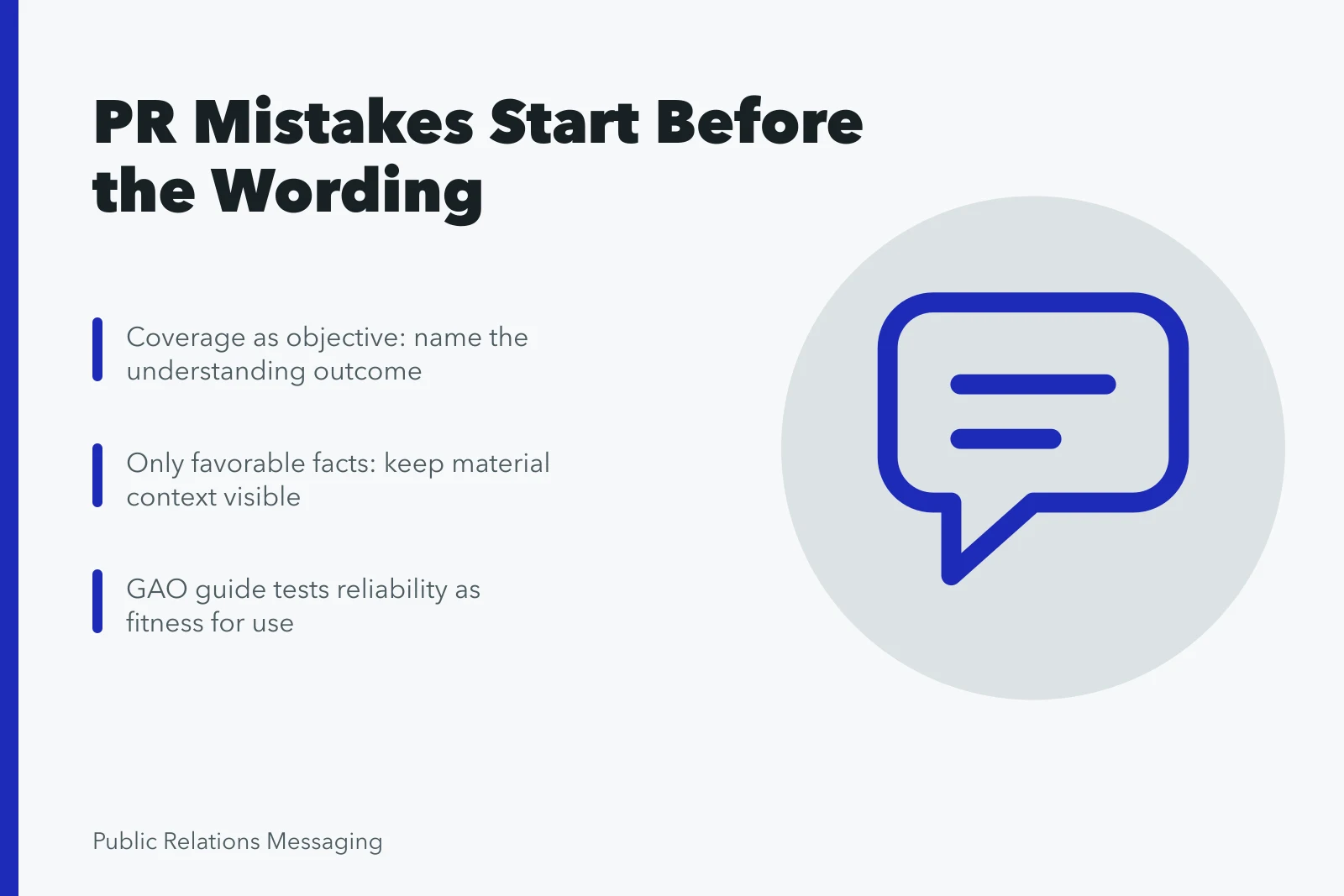
| Coverage as the objective | Attention has no defined public value | Name the understanding or relationship outcome |
| Only favorable facts | Omission changes the audience's interpretation | Keep material context and qualifications visible |
| One message for everyone | Different publics face different stakes | Use one fact base with audience-specific answers |
| Late employee notice | Staff cannot answer the public experience | Sequence internal readiness before external attention |
| Untrained spokesperson | Pressure produces speculation or evasion | Rehearse facts, hard questions, limits, and follow-up |
| No correction path | Errors remain live across channels | Preassign verification, pause, notice, and repair |
| Vanity reporting | Output is mistaken for outcome | Measure understanding, action, relationship, and harm |
Rehearsal needs three concrete steps. Someone writes the hardest questions the record can support, including the one the spokesperson hopes nobody asks. The spokesperson then practices the limits out loud: what is not known, what is not decided, who will answer it, and when.
A colleague then asks the same question three different ways. The spokesperson repeats the limit and commits to a follow-up time. Every follow-up gets logged and closed.
The vanity row needs its own numbers. Understanding: unprompted recall of the main fact plus correct answers to two or three comprehension questions, with the pass mark set before fieldwork. Action: the behavior the plan promised, counted from system records rather than clicks.
Relationship: trust and willingness to recommend, asked with identical wording each wave. Harm: complaints, corrections issued, and people who needed direct notice. A typical reporting bar is a shift larger than the survey's margin of error, held across two waves. Do not report one blended score.
Selective disclosure can create legal and credibility risk. Teams handling market-sensitive information need qualified counsel and current policies. A PR plan should name which disclosures require specialist review, who can speak, which audiences can receive information, how accidental disclosure is escalated, and where the approved public record lives.
The SEC's release adopting Regulation Fair Disclosure addresses selective disclosure of material nonpublic information by covered issuers and describes the rule's scope and disclosure framework. It is a specific securities-law source, not general legal advice or a rule for every organization and communication.
Media work also fails when a team treats reporters as a target list. Irrelevant pitches waste attention. Artificial exclusives, hidden payment, unavailable experts, unsupported embargoes, and slow fact follow-up undermine future access. Keep accurate beat notes, explain why the development matters now, state what is available, and accept an editorial no.
CDC's archived Working with the Media resource discusses message preparation, subject-matter review, audience focus, and advance planning. It also covers availability and constructive media relationships during emergencies. Its public-health crisis context does not turn every recommendation into a routine corporate media rule.
After a failure, preserve the actual materials and decisions. Compare the source facts, approved version, live placement, and audience targeting. Then compare the destination, spokesperson answers, and response records. Correct the exposed claim where people can encounter the correction. Then change the approval, access, evidence, or operational control that allowed the failure.
Keep the evidence record and set the review trigger
The GAO data reliability guide treats reliability as fitness for an intended use and requires documented assessment. Use that test for public relations strategy mistakes; the federal guide does not certify the local data.
The FTC advertising substantiation policy requires a reasonable basis before objective advertising claims are disseminated. Apply that U.S. rule to performance statements in public relations strategy, with advice for the actual facts.
For public relations strategy mistakes, keep the evidence record beside the decision so a reviewer can reproduce the reasoning without relying on memory. Set the next review date for public relations strategy mistakes and name the change that would trigger an earlier check.
Common questions
What is the most common PR strategy mistake?
Starting with a tactic or favorable story before defining the public problem, verified facts, organizational action, and realistic outcome.
Should a company respond to every criticism?
No. Verify the claim, source, reach, public need, and possible harm, then choose a proportionate response or documented non-response.
Can deleting a mistaken post solve the problem?
Deletion may stop further exposure, but affected people may still need a visible correction, direct notice, or remedy.