Strategy
How US cities use behavioral insights for public messaging
How US cities and Canadian agencies can source, scope, procure and evaluate behavioral insights public messaging pilots, with ethics review and measurement steps.
What to take away
- Behavioral insights public messaging pilots work best when they target one decision and one audience.
- The most copied model comes from New York City, but other cities need their own sourcing and ethics path.
- Procurement rules and ethics review, not message writing, usually set the timeline.
- Measure with a control group and pre-register the analysis before launch.
- Report null results. They guide the next test.
Where behavioral insights pilots start in a city
Behavioral insights public messaging applies psychology and economics to how governments write, time and deliver information. A pilot usually targets one behavior, such as filing a form or responding to a notice.
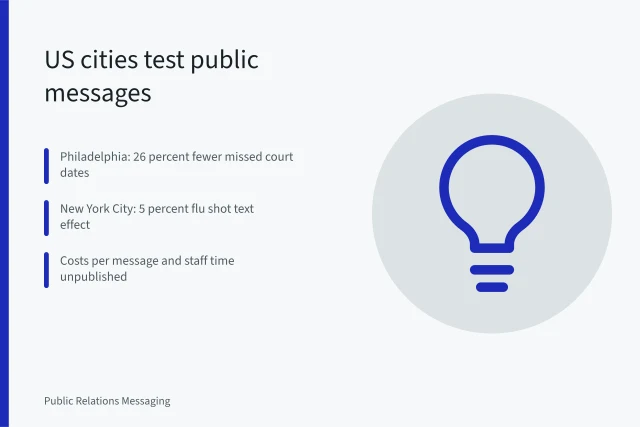
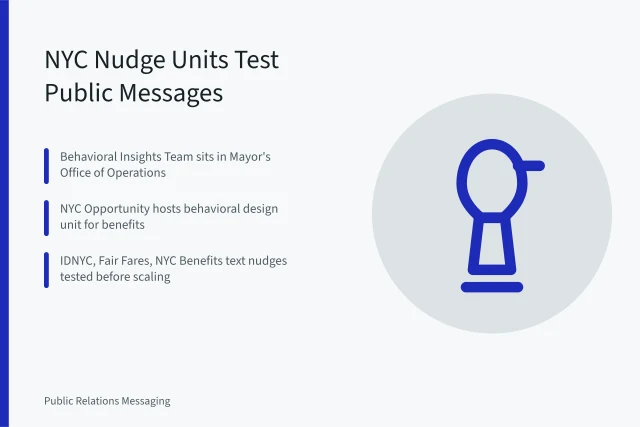
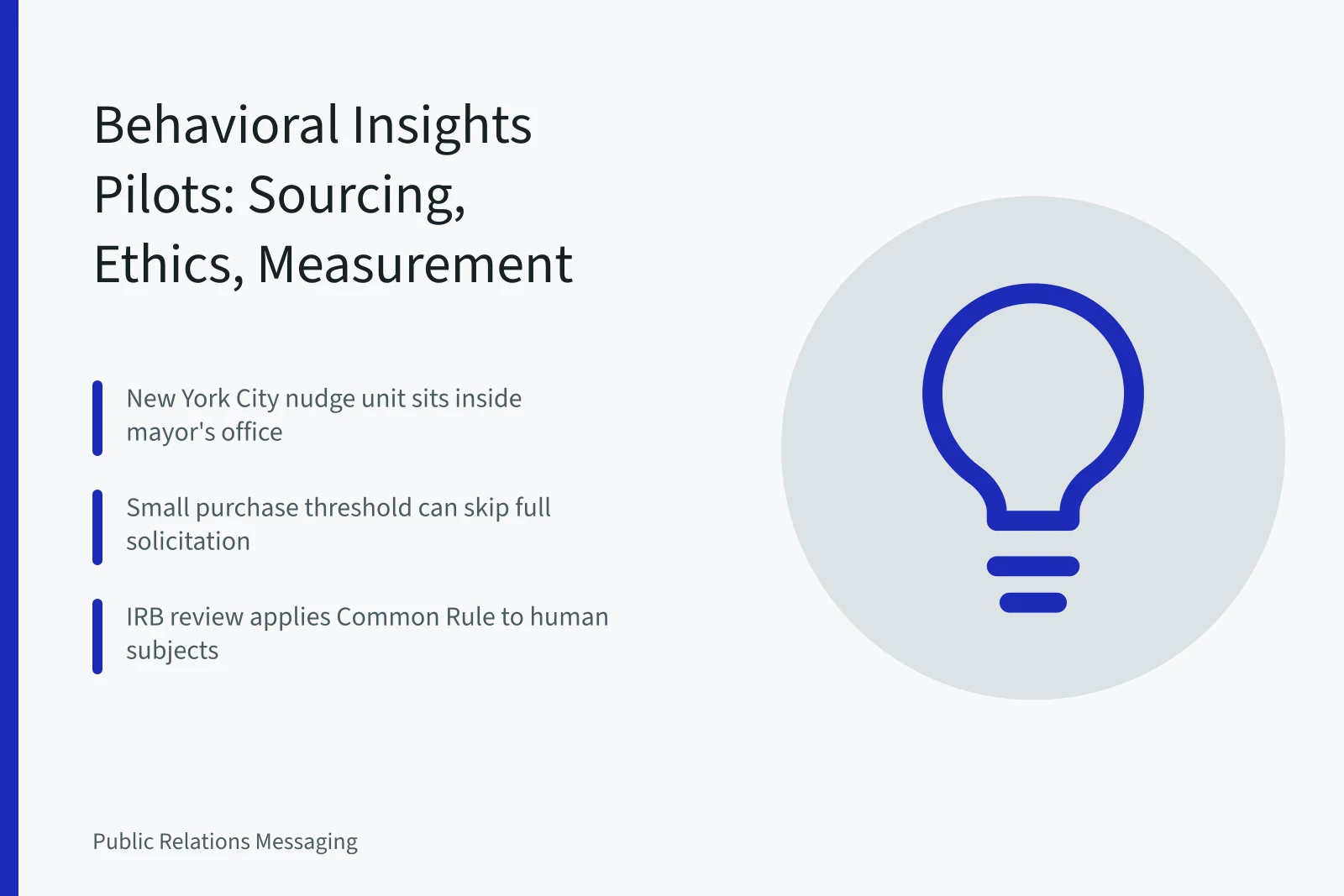
The most documented model comes from New York City nudge units, which test public messaging campaigns before scaling them citywide. That model works because the unit sits inside the mayor's office.
Other cities rarely have that structure. Some build a small in-house team. Others borrow researchers from a nearby university.
Bloomberg Philanthropies runs What Works Cities, which helps mid-sized cities use data and evidence. The Lab @ DC runs randomized evaluations for District of Columbia agencies. The Philadelphia Behavioral Science Initiative pairs city departments with academic researchers.
The Behavioural Insights Team, often called the nudge unit, has a North American office. Nonprofit firms such as ideas42 also advise governments.
Public messaging sits inside public relations, which studies how organizations build trust. Cities also separate public affairs from government relations, and that split decides who signs off.
Sourcing partners for a behavioral insights pilot
Sourcing partners
What it supplies
- In-house behavioral unit
- Design, testing, agency coordination
- University lab
- Review, random assignment, analysis
- Nonprofit design firm
- Field testing, message drafting, training
- National network
- Coaching, peer review, templates
How to engage
- In-house behavioral unit
- A small team inside the mayor's office
- University lab
- A research agreement and a data use agreement
- Nonprofit design firm
- A fixed-price contract with a short scope
- National network
- Membership or a coaching grant
Choose the smallest partner that can answer the question. A university lab may take longer than a firm because of review steps.
Procurement steps that shape the contract
Procurement steps
- Write a one-paragraph problem statement that names the decision and the audience.
- Check the city's small purchase threshold. Below it, a department may hire a consultant without a full solicitation.
- If the work exceeds that threshold, issue a request for proposals with a fixed evaluation plan.
- Require the vendor to name the outcome and comparison group before award.
- Add a data clause that covers who stores personal information and for how long.
- Reserve part of the budget for an independent review.
Procurement often pushes a pilot past a single budget year. Assume a competitive contract takes months.
Ethics review and data handling
Any pilot that studies people may need review by an Institutional Review Board. University partners apply the Common Rule, the federal policy for human subjects research, even when the city is not federally funded.
Cities should also check state privacy laws, public records rules and sector rules. Health messages touch HIPAA. School messages touch FERPA. A data use agreement should say what each side keeps and when both sides delete it.
Consent is often impractical for a mass message test. Many pilots use notice and an opt-out instead. An IRB can waive written consent when the risk is minimal.
Scope the ethics review at the same time as the procurement. Both take longer than the message writing.
Example: a mid-sized city tests a transit reminder
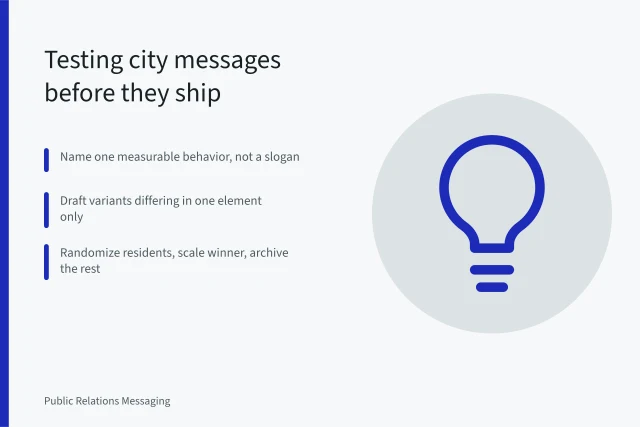
A transit agency wants more riders to reload a fare card before boarding. Staff write three reminder texts. One uses a loss frame, one uses a gain frame and one names a plain deadline. Riders are assigned at random to one message.
The agency pre-registers the main outcome and the analysis plan. After the test, staff compare reload rates across groups and report the result, including a null result if no message won.
If the agency pays local creators to share the message, the campaign should follow the FTC guidance on disclosures for social media influencers.
Measuring a behavioral insights public messaging pilot
The Behavioural Insights Team built the EAST framework: make a message Easy, Attractive, Social and Timely. Use it to draft options.
Random assignment is the strongest design. It lets a city compare a treatment message with a business-as-usual message and attribute any difference to the message. When random assignment is impossible, use a similar comparison group.
Pre-register the primary outcome, the sample size and the analysis. Pre-registration reduces the chance that a team finds a result by searching many outcomes. Report effect sizes and confidence intervals, not only significance.
Plan for spillover. If treated and untreated residents talk, the control group may change. If only some people open the message, the effect on the full population is smaller.