Strategy
Public messaging and behavioral insights: how US cities nudge residents
How US and Canadian municipal nudge units use behavioral science to test resident-facing messages, covering ethics, evaluation, and real tools.
What to take away
- Municipal nudge units turn behavioral science into tested messages for residents.
- Common tactics include social norms, deadlines, and simplified forms.
- Ethics demand transparency, privacy, and freedom of choice.
- Evaluation uses randomized controlled trials and pre-registered plans.
- US and Canadian cities share methods, with Ontario and British Columbia running provincial units.
Why behavioral insights public messaging matters for cities
Cities want residents to pay taxes, enroll in benefits, conserve water, and vote. Traditional notices often fail because they are long, confusing, or easy to ignore. Behavioral insights public messaging applies psychology to fix those failures.
Nudge units public sector teams study how people actually behave, not how they should behave. They then redesign messages to make the desired action easier. This approach is now common in US cities like New York, Chicago, and Philadelphia.
Canadian provinces like Ontario and British Columbia also run units. The goal is not persuasion for its own sake. It is to help residents follow through on intentions they already have.
Choice architecture messaging is a core part of this work. It changes the layout, wording, or timing of a message without removing any option. For example, moving a deadline to the top of a letter can increase response rates.
How nudge units public sector teams turn research into messages
A typical process follows these steps:
- Define the behavioral problem. Is the issue awareness, motivation, or friction?
- Diagnose with data. Review administrative records, surveys, and interviews.
- Design a message. Choose a behavioral principle like social norms or loss aversion.
- Test with a randomized controlled trial. Compare the new message to the current one.
- Evaluate and scale. If the effect is real and ethical, expand to more residents.
Choice architecture messaging in practice
Choice architecture messaging changes how options are presented without removing any. A table shows common principles and example message tweaks.
| Principle | How it shapes a message |
|---|---|
| Social norms | "Most residents in your neighborhood pay their water bill on time." |
| Salience | Put the deadline and amount at the top of the letter. |
| Planning prompts | Ask residents to write down when and where they will complete a form. |
| Loss aversion | Explain what a resident might lose by missing a deadline. |
| Simplification | Replace legal language with short, active sentences. |
Ethics and transparency in government public messaging
Government public messaging must avoid manipulation. Nudge units often follow ethical guidelines from academic research. These include informed consent for trials and protection of personal data.
Ethical nudging preserves freedom of choice. It does not deceive or coerce.
Municipal messaging borrows from public relations practice, which studies how organizations build trust with audiences. Public relations practice is a useful reference for these trust-building techniques.
Nudge units often coordinate with government relations staff to ensure messages align with policy and legal constraints. The scope of government relations covers this type of coordination.
Ethical guidelines warn against tactics that could be seen as media manipulation, such as hiding the source of a message. Understanding media manipulation tactics helps units avoid common pitfalls.
Example: Testing a reminder letter
Suppose a city wants more residents to renew business licenses. The nudge unit drafts two letters. The first is the current version.
The second adds a clear deadline, a simplified list of steps, and a social norm sentence. The unit randomly assigns businesses to receive one of the two letters.
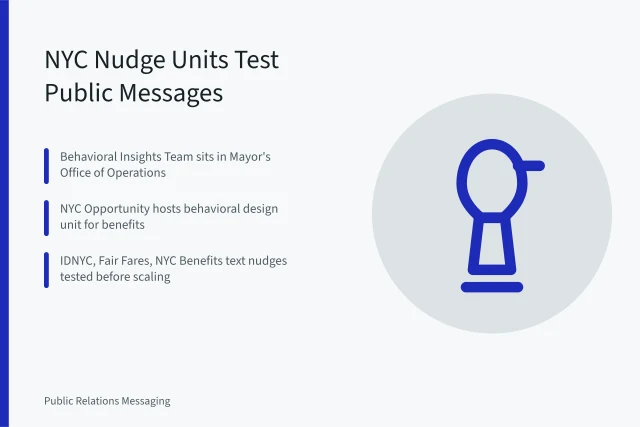
After a set period, they compare renewal rates. If the new letter performs better, the city adopts it. New York City has run similar tests for programs like IDNYC and Fair Fares.
For a detailed case study, see how New York City tests IDNYC messages before scaling.
Evaluation and scaling
Testing is not enough. Nudge units must evaluate whether a message works for all residents. They check for unintended consequences. For example, a message that increases compliance might also create fear.
Units use pre-registered analysis plans to avoid cherry-picking results. They also compare effects across neighborhoods. If a message works only for wealthy residents, it may not be fair. Successful messages are then scaled citywide. The NYC page describes how that scaling works in practice.
Pre-registration means the unit publishes its analysis plan before seeing results. This practice reduces the risk of false positives.