Strategy
Public messaging in US cities: how behavioral insights shape campaigns
How US city behavioral insight teams design and test public messaging, from writing variants to running randomized tests and scaling what works.
What to take away
- Behavioral insights public messaging starts with one measurable behavior, not a slogan or a tagline.
- City teams name the outcome firsta form filed, a benefit claimed, a call placed to 311.
- Small randomized tests decide which wording ships, and the losing version is discarded.
- Deadlines, plain wording, and social norms carry most municipal copy.
- Every campaign must clear procurement, accessibility, and public records review.
Where behavioral insight teams sit in city government
Behavioral insight teams seldom run an entire department. They sit inside a mayor's office, a health department, or a 311 operation, and they borrow people from communications, data, and legal.
The model traces to the Behavioural Insights Team, created inside the United Kingdom Cabinet Office in 2010 and later spun out as an independent company. United States cities built similar units, often alongside behavioral design firms such as ideas42.
The remit stays narrow on purpose. Pick a policy goal, find the single behavior blocking that goal, then test wording that moves it.
Public affairs staff own outward tone and press calls. A Wikipedia overview of public affairs separates that work from government relations, which deals directly with officials and legislators.
Turning a policy goal into a testable behavior
"Increase benefit enrollment" is not testable. A behavior is: a resident opens the renewal notice and files the form before the deadline.
Teams write the behavior down, then name the barrier. Frequent barriers include confusion about eligibility, missed deadlines, distrust of the sender, and simple inertia.
Each barrier points to different copy, so three or four variants get drafted before anything is printed or mailed.
Writing message variants that can be compared
Variants must differ in one element, or the test teaches nothing. Teams usually change the first sentence, the deadline, the sender, or the call to action.
| Element under test | Question the team asks | What gets measured |
|---|---|---|
| Sender | Which office signs the letter? | Response and call volume |
| Deadline | Is a date stated plainly? | On time submissions |
| Social norm | Do neighbors take part? | Enrollment share |
| Call to action | Is there one clear next step? | Clicks or calls per mailing |
Keep formatting identical across variants. Font, page count, and postage class stay fixed so the wording is the only difference.
Running a test cycle, five steps
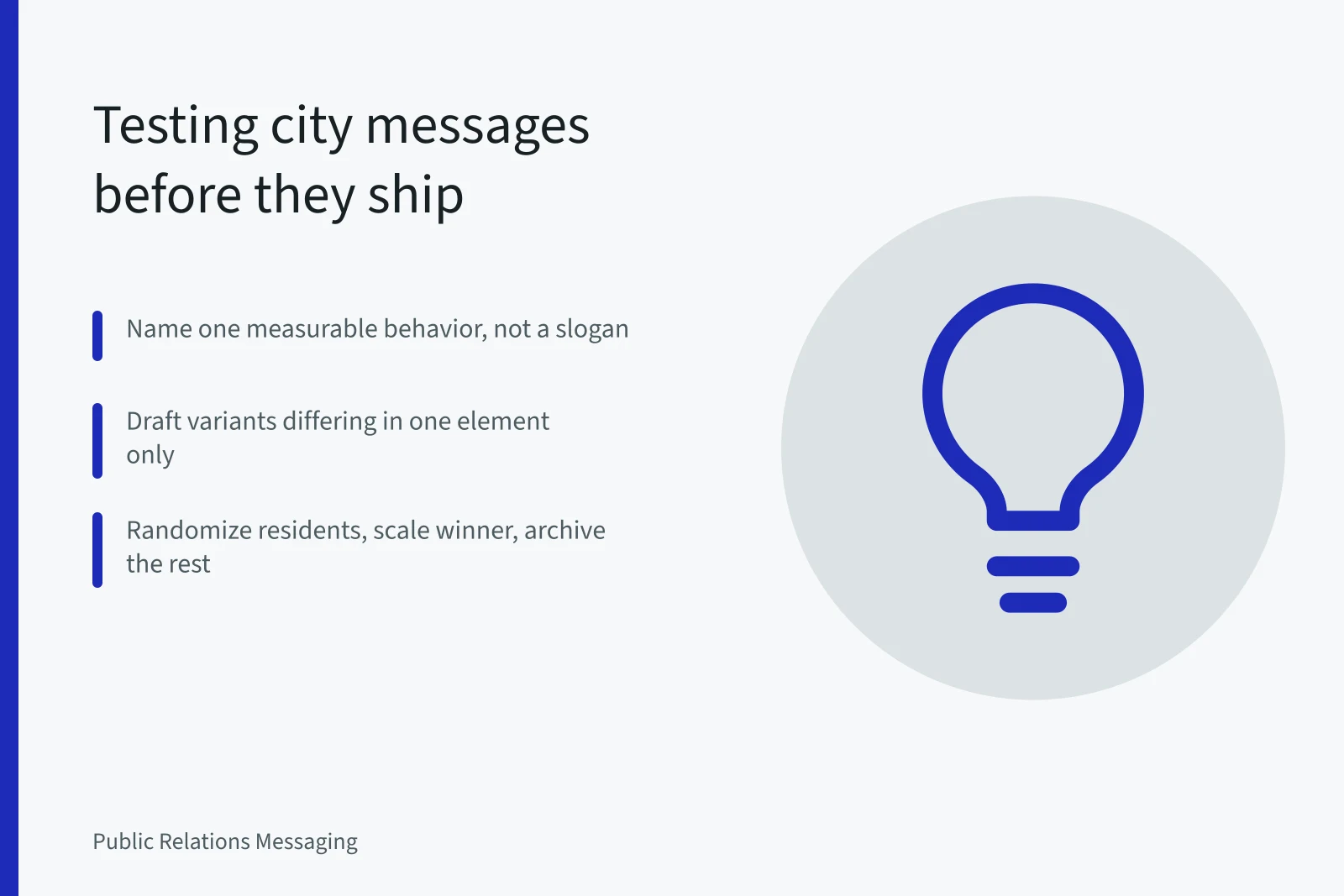
- Define the behavior and the single metric that proves it happened.
- Draft variants that differ in one element only.
- Assign residents at random to a version, using a channel the city already owns.
- Read the results, then check whether the winner holds across language groups.
- Scale the winning version and archive the rest with its data.
Analysts watch for backfire effects too. A message that shames residents can reduce response, and a deadline that sounds like a threat can push people away.
A version that wins one test can lose six months later. Season, news cycle, and staffing all shift the baseline.
Example: IDNYC and Fair Fares in New York City
City campaigns often begin as small pilots on one mailing list or one 311 script. New York has run this pattern for IDNYC, the municipal identification card, and for Fair Fares, the reduced fare transit program.
For a worked municipal case, see how the New York City nudge unit moves psychology principles into campaign copy.
The pattern repeats elsewhere: a pilot on one mailing list, a rewrite, then a citywide rollout only after the numbers hold.
Procurement, accessibility, and disclosure rules
Contracts shape messaging more than most press offices admit. Printing, translation, and paid placement all run through vendor lists, purchase orders, and city time.
Accessibility rules are not optional. Public campaigns must work with screen readers, large type, and the languages residents actually speak at home.
Paid placements carry extra duties. When a city or its contractor buys sponsored content, the FTC native advertising guide explains that readers must be able to identify it as advertising.
The wider field has its own conventions. Most city teams borrow frameworks from general public relations practice, and the Wikipedia entry on public relations traces where those frameworks came from.
What it costs and how long it takes
A small wording test usually runs on existing mail, email, or call scripts, so the added cost is staff time plus analysis, not new media buys.
Timelines stretch for three reasons: legal review of the claims, translation into required languages, and the print or broadcast schedule already booked.
Counting starts before the test ends. If the outcome takes a year to appear, teams report the intermediate step, such as form starts, and label it as such.