Costs
Part of Marketing communications strategy: the version that survives contact with reality
The operating standard behind marketing communications strategy: what it requires
marketing communications strategy best practices connect audience research, plain language, claims, accessible formats, channel roles, testing, and learning.
What to take away
- Use the audience's decision and language to resolve internal preferences.
- Make proof, qualifications, and next steps easy to find and understand.
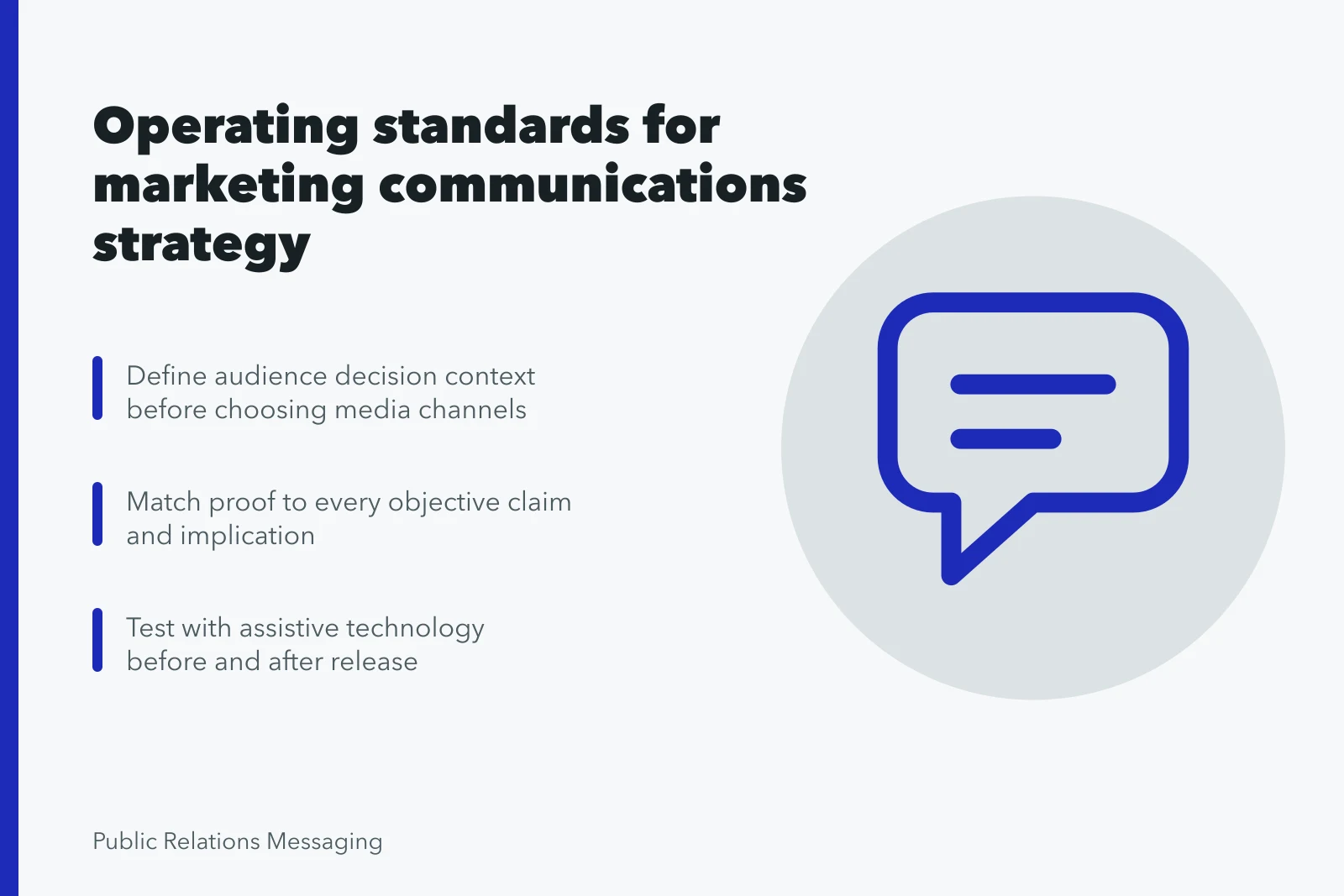
- Test with people and assistive technology before and after release.
Marketing communications strategy best practices are operating habits that improve the odds of clear, responsible work. They do not guarantee attention, persuasion, revenue, or compliance. Apply them with current audience evidence, qualified review, production testing, and a correction process that matches the campaign's risk.
Apply the operating standard
| Practice | Team behavior |
|---|---|
| Audience before channel | Define the decision context and evidence before choosing media |
| One main conclusion | Make the intended meaning easy to repeat accurately |
| Proof before promise | Match support to every objective claim and implication |
| Plain language | Use familiar words, direct structure, and concrete actions |
| Accessible production | Design and test for varied ways people receive information |
| Distinct channel roles | Coordinate discovery, explanation, validation, and action |
| Complete handoff | Make destinations, response, and service honor the message |
| Learning cadence | Review evidence, exceptions, and changes, not output alone |
Use audience language without copying stereotypes or surveillance labels. Learn from interviews, queries, conversations, task observation, and service records. Write for the knowledge and pressure in the decision. Define unfamiliar terms, lead with the key point, use descriptive headings, and state what action is possible now.
Audience language gathered this way feeds directly into marketing communications strategy development, where each decision narrows the choices that follow.
Digital.gov's plain language principles emphasize writing for a specific audience, organizing information, using direct language, and testing whether content communicates its intent. The federal legal context described on the page applies to government, but the audience-centered writing practices can be tested in business communication.
Manage consistency through a verified message system, not a copy-and-paste rule. Maintain the main conclusion, supporting points, proof, qualifications, vocabulary, identity, and prohibited implications. Let each channel answer the audience's immediate question. A short feed item should lead to complete context; a sales conversation should not invent promises absent from the approved evidence.
Design accessibility into the brief: budget for captions, transcripts, alternative text, keyboard operation, and readable contrast.
Budget for clear forms, structured documents, language support, and an accessible alternative when a platform cannot deliver the needed experience.
Automated checks help find selected defects; human review and user testing cover missed meaning and interaction. A marketing communications strategy checklist prevents late drops of captions, transcripts, and alternative text.
W3C's WCAG 2.2 quick reference organizes web accessibility success criteria and techniques by principles, levels, and filters. It is a technical reference, not a certification of a campaign or a substitute for determining which legal requirements and user needs apply.
- Invite claim and risk reviewers during concept development
- Pretest comprehension, credibility, relevance, and action
- Pilot the complete route with response capacity in place
- Verify the exact live creative, audience settings, and destination
- Read questions and complaints beside performance metrics
- Retire stale claims and revoke obsolete access
- Publish corrections where affected audiences can encounter them
Assign the practice
The NIST Privacy Framework starting guide outlines a voluntary process for identifying and managing privacy risk. Use it to assign data and response owners for marketing communications strategy best practices; it is not legal clearance.
The CISA business-system logging guidance explains how event records support security review. Preserve appropriate marketing communications strategy best practices access, change, failure, and correction records without claiming that logging validates a metric.
For marketing communications strategy best practices, keep the evidence record beside the decision so a reviewer can reproduce the reasoning without relying on memory.
Common questions
Does plain language mean oversimplifying?
No. It means presenting the necessary complexity in words and structure the intended audience can understand and use.
Is an accessibility checker enough?
No. Automated checks cover selected technical patterns. Manual inspection, assistive-technology testing, and feedback from people with disabilities remain important.
How can teams stay consistent without sounding repetitive?
Keep the facts, promise, evidence, and identity consistent while adapting depth, format, examples, and action to each audience context.