Strategy
4 things nobody tells you about no-makeup looks trends
No-makeup looks trends for 2027, read from the other side: what a trend piece is assembled from, five questions that settle it, and what never changes.
This page does not tell you what is trending. It tells you how to read the pages that do, which is more durable, because a trend claim written in one month is furniture by the next.
Trend coverage in beauty is a format with a fixed shape. Once you can see the shape, most of these pieces answer themselves in about ten seconds.
What to take away
- A trend story is a claim about other people's behavior, and it almost never says how that behavior was measured.
- Ask who benefits from you believing it. A named product in the third paragraph answers the question on its own.
- Renaming an old thing is the most common way a new trend is produced, and the rename is the only new part.
What a trend piece is usually assembled from
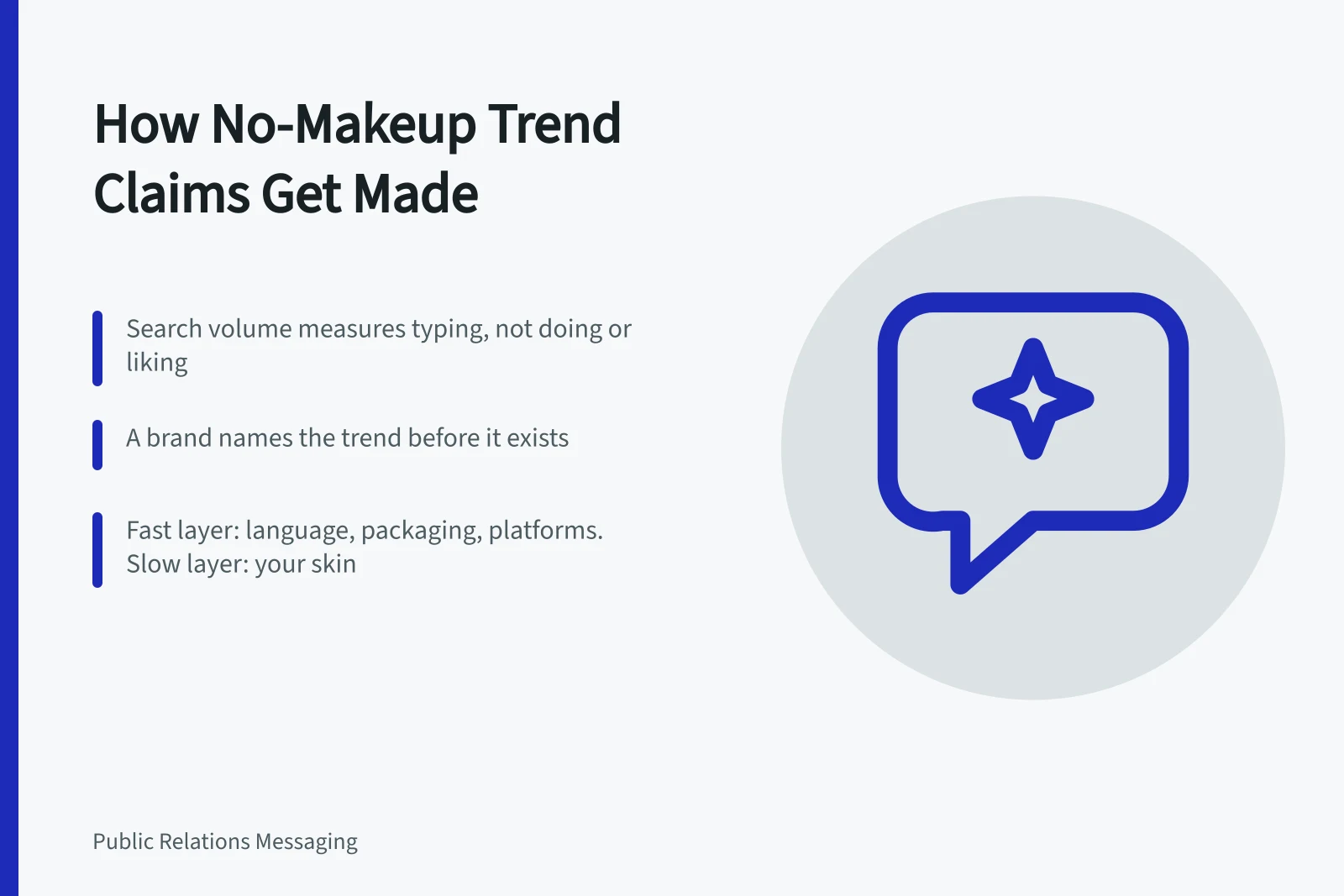
- A search term that rose.Often the whole evidence base. Search volume measures what people typed, not what they did or liked.
- A platform's own promotion.If a feed pushed something for a fortnight, the resulting rise is the feed, not the public.
- A brand's campaign.Launches are timed, briefed to writers and given a name in advance. The name arrives before the trend does.
- One expert quote.Frequently supplied through a public relations agency along with the product being discussed.
- A rename.The same look, from an earlier decade, with a fresh compound noun attached.
- Occasionally, something real.People genuinely do change what they buy and wear. It happens slowly and it rarely arrives with a hashtag.
None of that makes the piece dishonest. It makes it advertising-adjacent journalism, which is a normal thing to be, and which you can read productively once you know that is what you are holding.
Five questions that settle it quickly
- Who is quoted, and who pays them?A stylist, a dermatologist and a founder are not the same witness, and only one of those three has a product to move.
- What is the evidence that anybody is doing this?A number of posts is not a number of people. A search rise is not a purchase.
- Is there a product named?If so, read the rest of the piece as a campaign and see whether it still holds. Where the arrangement behind a placement has to be stated, and how visibly, is the subject of the Federal Trade Commission's guidance on making disclosures effective in digital advertising.
- Is this new, or newly named?Look at the photographs. If your parents would recognize the look, the trend is the noun.
- What would change if I ignored it?Usually nothing, which is worth noticing before you spend anything.
What actually changes, and what does not
The fast layer is language, packaging, formats and the platform a claim arrives on. It turns over constantly and none of it is about the face in the timeline or your own.
Fast layer vs slow layer
Fast layer
- What it covers
- Language, packaging, formats
- How fast it moves
- Constantly
- About your face?
- No
- Effect on the other
- None
Slow layer
- What it covers
- Skin, budget, light, routine
- How fast it moves
- Barely at all
- About your face?
- Yes
- Effect on the other
- None
The slow layer barely moves at all: your own skin and how it behaves, what you can afford to keep buying, what suits the light where you live, and whether you enjoy the routine enough to continue it. Nothing in the fast layer changes anything in the slow one.
One change is technical, not stylistic. Cameras and apps process faces at capture by default, without telling you. Work that once sat in a separate stage of image editing happens before the file exists.
Reference images in every trend piece are further from the room than before. The consequences for the before-and-after format are in before and after timelines.
Reading celebrity transformation timelines this way
The same habits apply to celebrity beauty and cosmetic transformation timelines. A before-and-after grid is a claim about change over time, and the slow layer still decides what is visible: lighting, angles, makeup, camera processing, and the years between photographs.
Treat a transformation timeline as evidence to question, not a look to copy. Ask when each image was taken, what changed in the frame, and what the person has said about procedures.
Where a timeline is built from red carpet photos, the gaps matter more than the captions. This site is about those timelines, so the questions above are not side notes here. They are the point.
If you like the look anyway
Wanting a style is a perfectly good reason to try it, and it needs no trend to justify it.
Use the picture as a starting point for a description, not a target, and name what you like: a color, a level of coverage, a finish. Then ask if you can say it in words you could hand to another person. Test one thing at a time in your own light.
The failures worth avoiding along the way are collected in no-makeup looks mistakes, and the category itself is explained in no-makeup looks.
Common questions
Why won't you publish a list of what is trending for 2027?
Because the honest version would be a list of things brands are launching, which is a calendar rather than a report, and because it would be stale within weeks while sitting on this site for years.
Is a trend piece worth reading at all?
Yes, as a window on what is being sold and how. Read it for the mechanics rather than the instructions and it becomes genuinely interesting.
A clinician was quoted saying a certain look reflects a certain procedure. Is that reliable?
Commentary about what has been done to a face somebody has never examined is not an assessment, whatever the qualification of the person offering it. That genre is taken apart in beauty expert analysis. Anything about your own face belongs to a practitioner who has looked at it.