Rules
Part of Getting media relations right the first time
A framework for tracking media relations trends
Use this practical framework to track media relations trends: maintain a dated signal register, assess evidence, and connect signals to controlled responses.
What to take away
- News discovery is spreading across platforms, formats, creators, outlets, and direct sources.
- Synthetic production increases the need for origin, alteration, rights, and verification records.
- Own durable facts and response capacity even when distribution is external.
Media relations trends should guide questions and tests, not automatic spending. Maintain a dated signal register with the source, markets, population, behavior observed, uncertainty, relevance to the organization's publics, possible response, owner, trigger, and next review.
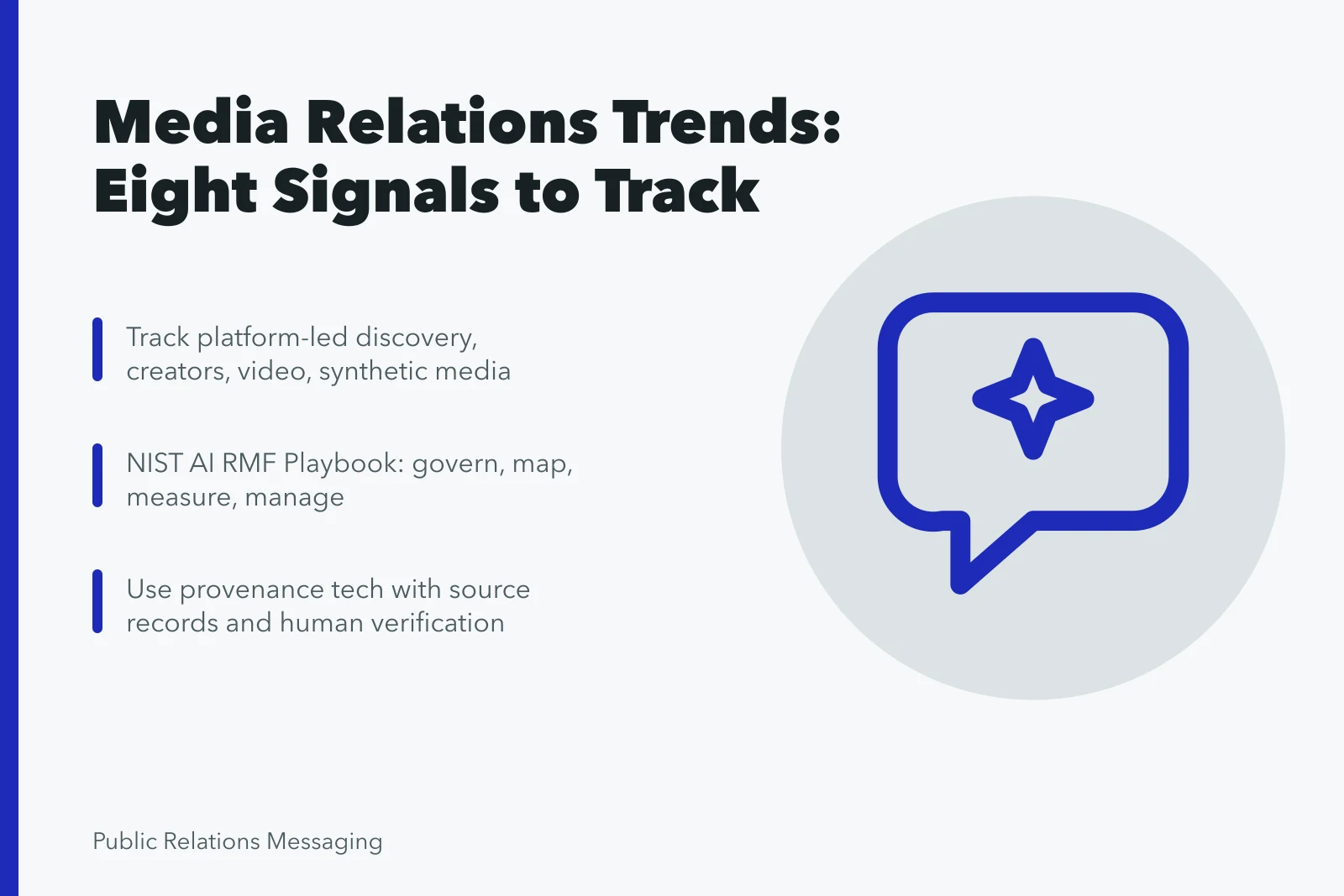
Track eight decision signals
| Signal | Question for the media team | Controlled response |
|---|---|---|
| Platform-led discovery | Where does each public encounter news now? | Map routes without assuming one global pattern |
| News creators | Who explains the topic outside traditional outlets? | Research role, audience, independence, and disclosure |
| News video | Which stories need visual proof or explanation? | Prepare accurate reusable assets and qualified speakers |
| Synthetic production | How was an asset created or altered? | Require provenance, rights, disclosure, and review |
| Direct source pages | Where can a person verify the full account? | Maintain stable records, updates, and corrections |
| Fragmented metrics | Which exposure and referral paths are invisible? | Use bounded measures and audience research |
| Automated outreach | Where can scale create irrelevance or privacy risk? | Limit recipients, data, variants, and send authority |
| Correction velocity | How fast can an error cross formats and platforms? | Keep monitoring, source files, placement lists, and pause control |
Before using the Reuters Institute's Digital News Report 2026 as evidence, verify that the edition has been published and review its country samples, survey methods, definitions, and fieldwork dates. Do not apply global findings to a business audience without checking their fit.
Eight media relations decision signals
Platform-led discovery: where does the public encounter news?
News creators: who explains the topic outside outlets?
News video: which stories need visual proof?
Do not replace journalist research with a broad creator list. Creators may report, comment, entertain, advocate, or sell, and those roles can overlap; verify each person's actual work, audience, commercial relationships, standards, and relevance. Classify paid participation accurately and keep independent editorial boundaries where they exist.
Classifying each creator accurately matters because media relations mistakes often start with a list that mixes paid and editorial roles.
Prepare video, audio, photographs, data visualizations, and recordings as evidence-bearing assets. Keep originals, source details, dates, locations, people, permissions, editing history, captions, transcripts, alternative text, and known limits. Synthetic or materially altered media needs a clear policy and a correction path that works after reposting.
The C2PA Content Credentials explainer describes a cryptographically bound structure for recording media provenance and explicitly notes that provenance alone cannot determine whether content is factually true. It is a technical explanation, not proof that a given asset, signer, or workflow is trustworthy.
As referral and exposure data fragment, measure what can be defended. Sample whether coverage is accurate and useful. Ask intended publics where they encountered and verified information. Track qualified inquiries, repeated questions, service outcomes, corrections, and issue resolution. Keep uncertainty visible instead of forcing every influence path into one attribution chart.
Maintain a dated watchlist
The NIST AI RMF Playbook offers voluntary AI-risk actions under govern, map, measure, and manage. Use them when AI changes media relations trends; the playbook is not a product ranking or forecast.
The W3C Privacy Principles statement gives web-system designers shared privacy concepts and warns against shifting privacy work to individuals. Apply it to media relations trends, then review the governing law and configuration.
For media relations trends, keep the evidence record beside the decision so a reviewer can reproduce the reasoning without relying on memory.
Common questions
Which 2027 media trend deserves the most attention?
The answer depends on the public and issue. For many teams, distributed news use and synthetic media increase both access opportunities and verification risk.
Should every press asset have Content Credentials?
Use provenance technology when it fits the workflow, but keep source records and human verification because a credential cannot establish factual truth by itself.
How often should media trends be reviewed?
Review signals on a set cadence and when new research, platform behavior, regulation, audience habits, or organizational exposure changes materially.