Costs
Part of Getting media relations right the first time
Media relations case studies: how to read one and test the transfer
A method for reading media relations case studies: an eight-field card, a worked example, source checks, and a five-step transfer test with a stop rule.
What to take away
- Extract the design and the parallel activity before you extract the result.
- Record earned media separately from paid, owned, partner and operational work.
- Turn the lesson into a bounded decision and test it with a stop rule.
- Cite the original case by title and link so a colleague can check your reading.
- Treat award write-ups as claims and journal articles as evidence.
Read the original record, not the summary
A campaign summary keeps the result and drops the design. That is the wrong half. The design shows which comparison was made, who was measured, and what else ran in the same period.
Read the methods section first, then the limitations, then the results. Read the limitations twice. They name the alternative explanations the authors could not rule out.
Media relations teams that skip this step borrow the headline and leave the conditions behind. The original record is the only place the conditions survive.
Extract every case into the same eight fields
Eight fields
- Public
- Who was in scope, affected, and actually reached
- Development
- What made the story timely or useful to a reporter
- Media intervention
- Which pitches, spokespeople, data, or events earned coverage
- Other intervention
- Paid, owned, partner, service, and policy work in the same period
- Evidence
- Documents, datasets, and interviews behind the narrative
- Measure
- Exposure, response, behavior, and outcome definitions
- Limit
- Alternative causes, missing data, and transfer gaps
- Lesson
- The bounded decision the team will test next
Fill the card from the source, never from memory. Where the source is silent, leave the field blank. A blank is a finding, and it caps how far the lesson travels.
Example: a filled card for one milk campaign
A CDC journal article reports community campaigns in small West Virginia markets that promoted a switch to lower-fat milk (CDC Preventing Chronic Disease, 2005). Paid advertising, earned coverage, and community activity ran together.
Filled card: milk campaign
- Public
- Adults buying milk in small West Virginia markets
- Development
- A simple dietary swap with a measurable retail signal
- Media intervention
- Earned coverage alongside paid advertising and community activity
- Other intervention
- Paid advertising plus in-store and community promotion
- Evidence
- Supermarket milk sales and a survey of reported behavior
- Measure
- Sales of lower-fat milk and self-reported consumption
- Limit
- No control market, small markets, self-report, parallel activity
- Lesson
- Test one media push with retail support, then stop if sales do not move
The card gives the honest reading. Media relations was one input beside paid advertising and community activity, so coverage cannot be credited with the sales shift.
A second CDC article covers a 2016 New York program aimed at health care providers (CDC Preventing Chronic Disease, 2019). It reports a survey of 400 providers, ad awareness, and an association with smoking-cessation assistance.
That case is targeted paid media inside a wider health strategy, not earned coverage alone. Teams comparing formats should open media relations examples, which keep paid, earned and community activity apart.
Where to find credible case studies
- PRSA Silver Anvil Awards archive: full entries with objectives and results.
- PRWeek Awards and the SABRE Awards: strong on tactics, written by the entrant.
- Institute for Public Relations: research-based case studies and literature reviews.
- Journal of Public Relations Research and Public Relations Review: methods sections survive peer review.
- Preventing Chronic Disease: the CDC journal that published both cases above.
Award archives show what entrants chose to report, which is not the same as what happened. Read the stated objectives and the measured result, then note what nobody measured.
Check the source type before you cite it:
- Peer-reviewed articledesign, sample and limits survive review.
- Institute reportevidence is aggregated, so trace the original studies.
- Award entryobjectives and results are self-reported.
- Vendor write-upthe audience is a buyer, not a researcher.
Match your verbs to the evidence
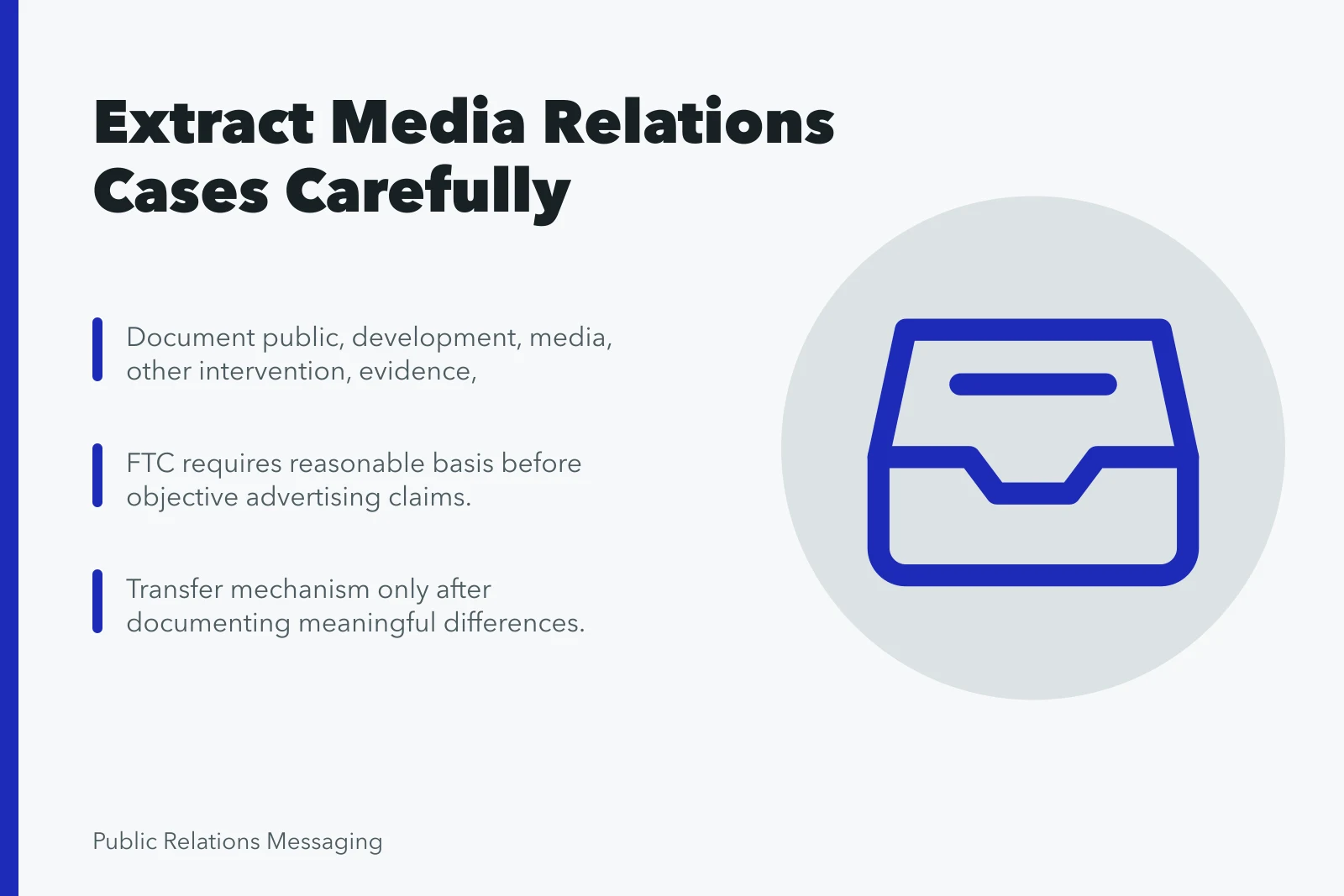
The FTC policy statement on advertising substantiation requires a reasonable basis for objective claims before they are disseminated. The same discipline applies when you restate a case in your own deck.
Use reported, observed, estimated, or associated when the source isolates nothing. Reserve caused for designs that ruled out the parallel activity. If you publish your own write-up, strategy case studies explains what each format should preserve.
Test transfer before you promise it
- List the differences that matteraudience, message, market size, baseline behavior, editorial interest, distribution, service capacity, and measurement.
- Rate each one as small, material, or fatal for your setting.
- Run the smallest test that can fail, with a stop rule agreed in advance.
- Set the review date and the trigger that brings it forward.
- Log the result against the card, including the field the source never filled.
A case study buys a hypothesis. It never buys a result.
Write the difference list before you name a budget. A material gap in audience or editorial interest can sink a mechanism that worked elsewhere. Size alone rarely does, and a large transfer gap does not always mean a large cost.
Pick the measure that would tell you the mechanism failed. Exposure will not do it. Use a behavior or service number you already track.
Keep the media relations checklist beside the card so every gate has an owner and a closing date.