Operations
Part of Public relations strategy: the choices that shape everything else, 2027 edition
Which public relations strategy questions actually get resolved?
common public relations strategy questions cover objectives, publics, messages, media, ownership, crises, budgets, ethics, measurement, and realistic outcomes.
What to take away
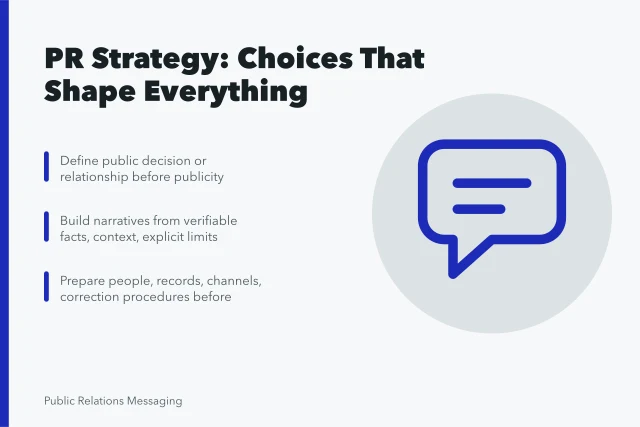
- PR strategy starts with a public or relationship problem, not a coverage target.
- Public relations is not advertisingplacement is bought, editorial attention is earned, and the work reaches past media into employee, community, and issues communication.
- Verified facts, organizational behavior, and communication must support the same account.
- Measure understanding, response, and relationships as well as media output.
Common public relations strategy questions tend to appear after a team has drafted tactics. Answer them before choosing announcements, interviews, events, or channels. Each answer should connect a real public need with supported facts, an organizational decision, a responsible owner, and a way to learn.
Use direct working answers
| Question | Working answer |
|---|---|
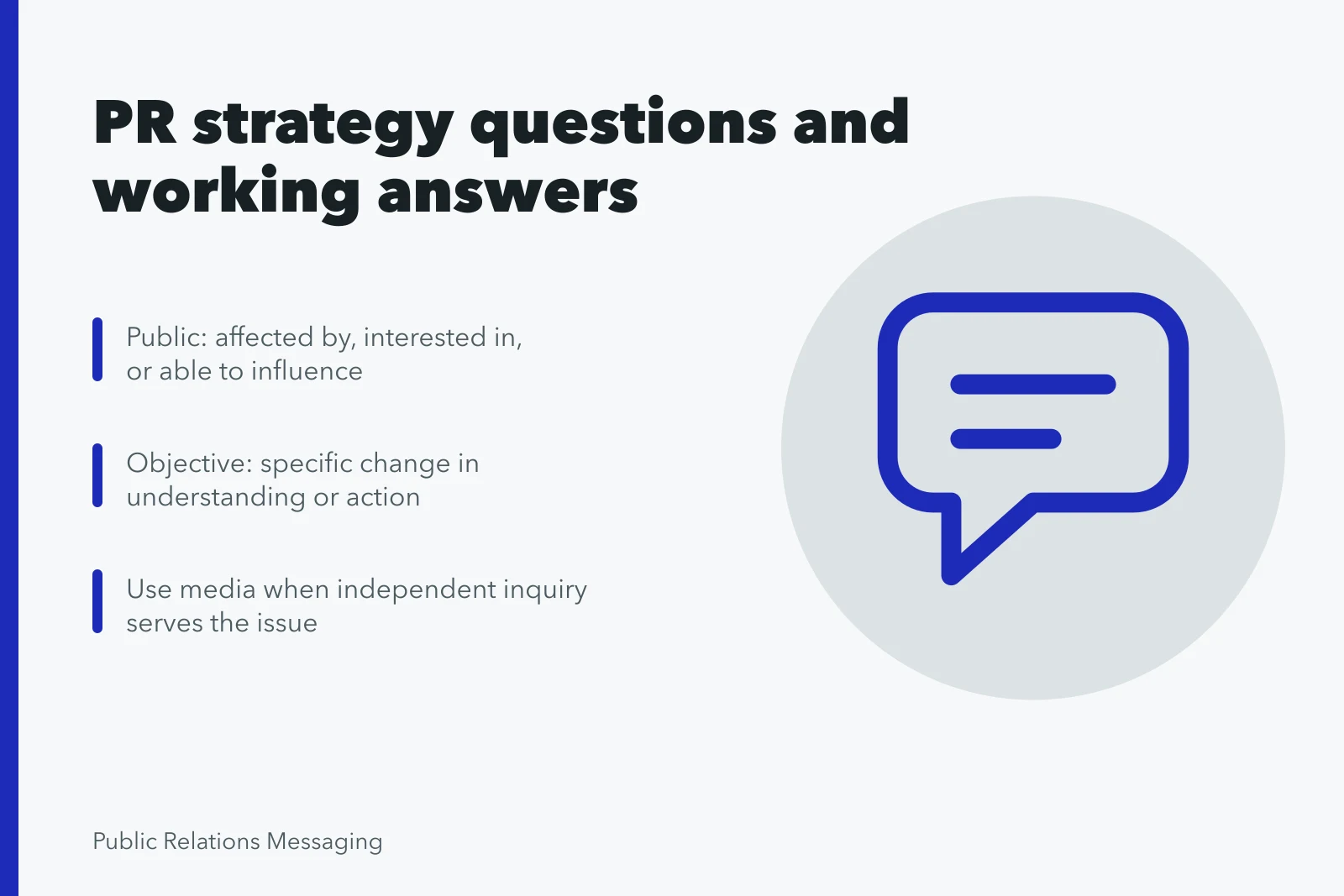
| Who counts as a public? | People affected by, interested in, or able to influence the issue |
| What is the objective? | A specific change in understanding, access, relationship, or action |
| What is the story? | A truthful account built from facts, context, action, limits, and relevance |
| When should media be used? | When independent inquiry or broader public explanation serves the issue |
| Who approves facts? | The accountable subject owner, with risk review where needed |
| What prepares a spokesperson? | Evidence, hard questions, limits, format practice, and follow-up |
| What should be measured? | Output, exposure, understanding, response, relationship, and outcome |
| What happens during an error? | Verify, contain, correct, notify, document, and prevent recurrence |
Advertising generally buys controlled placement. Media relations seeks legitimate editorial attention without controlling the resulting story. Public relations is broader than both: it can include employee communication, public information, community engagement, issues work, events, research, executive communication, owned content, and the operating response behind a promise.
The CDC describes its CERC manual as an evidence-based framework for organizational communicators in major emergencies, and its crisis setting needs care when adapting the material to routine business communication.
A journalist does not owe an organization favorable coverage or publication. Offer a verifiable development, relevant context, available sources, and responsive follow-up. Respect an outlet's editorial independence. Paid, sponsored, affiliate, or supplied content requires a different process and clear disclosure. Do not describe paid placement as earned coverage.
The U.S. Department of Justice explains that its Office of Public Affairs handles communication with news media and the public about department activities, a scope that no private team has to copy.
Budget for research, accessible production, source verification, spokesperson preparation, monitoring, response coverage, evaluation, and correction, not only distribution. Assign a reserve for foreseeable issues. If facts or operations do not support the proposed story, change the work before changing the wording.
Typical budget lines, to be confirmed by supplier quotes, sit in these bands. A message and audience study runs $2,000 to $15,000. Monitoring and media database tools run $300 to $2,500 a month. Spokesperson media training runs $1,500 to $6,000 per person, and evaluation runs $2,000 to $12,000 per program cycle.
Resolve the question with a decision record
The GAO evaluation design guide connects evaluation questions with evidence needs and design choices, and that discipline applies to common public relations strategy questions.
Each record holds six fields: the question, the evidence, the decision, the owner, the review date, and the trigger that forces an earlier review.
Worked example. A regional clinic plans to cut Saturday lab hours.
Field / Example
- Issue
- Cutting Saturday lab hours at a regional clinic
- Public
- Patients who use weekend draws
- Objective
- They know the new schedule and the alternative site before the change
- Owner
- Lab operations manager
- Measure
- Share of weekend patients who arrive at an open site, reviewed for four weeks
Where personal data is involved, the W3C Privacy Principles statement gives web-system designers shared privacy concepts and warns against shifting privacy work to individuals.
Common questions
How long should a PR strategy be?
Keep the core choices concise, then attach research, messages, fact records, workstreams, approvals, readiness plans, budgets, and measurement definitions.
Should every organization issue press releases?
No. Use a release only when the development and audience justify that format. Direct outreach, an owned update, or no announcement may be more useful.
Can PR guarantee media coverage?
No. A team can improve relevance, evidence, access, and responsiveness, but editorial decisions remain with the outlet.